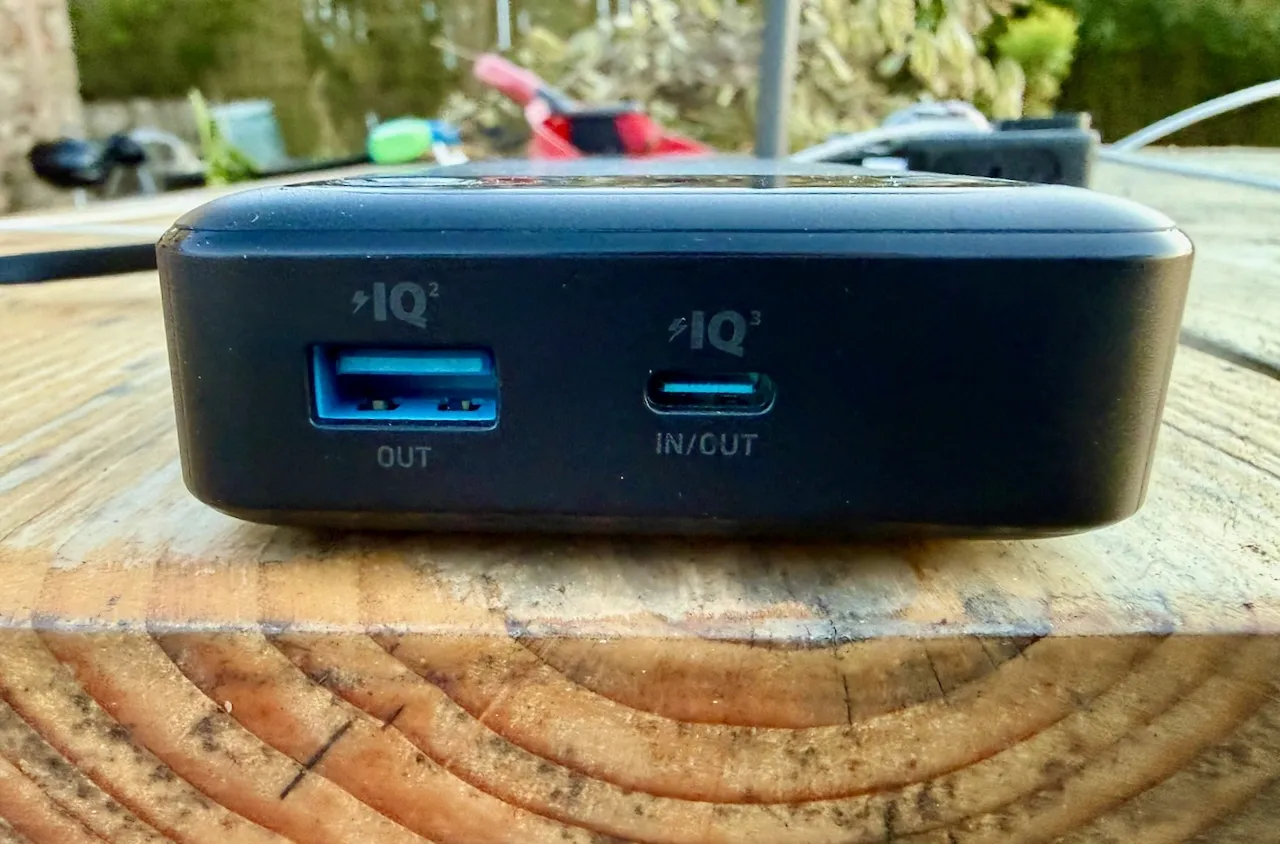
(Affiliate link)
When you’ve spent good money on decent tech, you quickly realise how dependent you are on it. Phone, watch, laptop. All useful right up to the moment the battery dies.
For trips away, especially anything off-grid, a reliable power bank stops being a nice-to-have and becomes essential.
I chose this Anker 20,000mAh portable charger. I’ve had it since December 2025, used it on several trips, and more recently put it through a fairly obsessive round of testing at home.
I’m very happy with it.
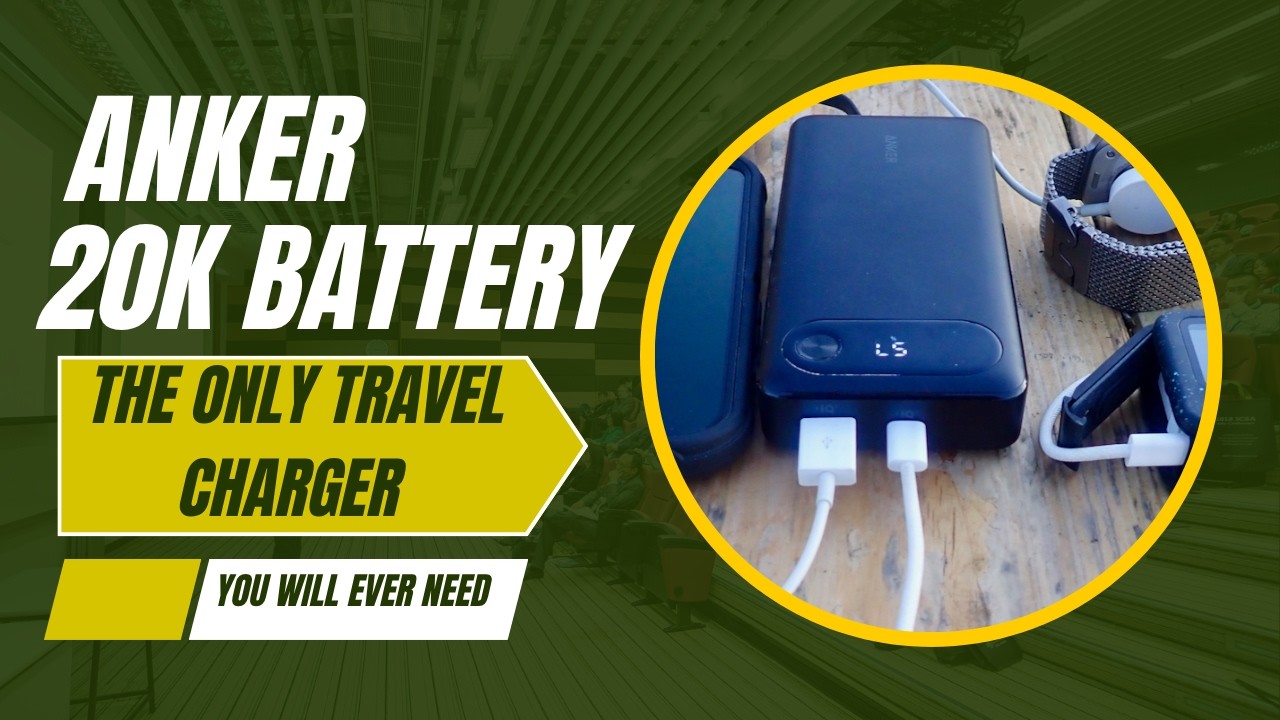
TL;DR
- Kept my iPhone 16 Pro going for about 4 days
- Ran out during day 5
- Recharges very quickly when you get the chance
- Built-in percentage display is genuinely useful- way better than the 4 vague LEDs you often get
- Integrated USB-C lead is a simple but excellent feature
- The last 10% does not do anything

Main features
- Built-in USB-C lead that can both charge devices and recharge the power bank
- Fast charging up to 87W
- 20,000mAh capacity, roughly comparable to a MacBook Air battery in energy terms
- Digital display showing exact remaining charge
- Can charge up to three devices at once
- Charges itself quickly, I saw around 64W in real use
- Size roughly similar to an iPhone Pro in a case
- Weight 421g. For context, my phone is 262g and a pint of water is about 840g

What is mAh?
Power banks are usually rated in mAh, which stands for milliamp hours.
In simple terms, it is a measure of how much electrical charge the battery can deliver over time.
So a 20,000mAh battery could theoretically supply:
* 20 amps for 1 hour
* 1 amp for 20 hours
That is useful, but not the best way to compare devices.
A better unit is watt hours, which accounts for voltage as well:
Wh = (mAh × Voltage) ÷ 1,000
Most lithium batteries use cells at around 3.7 volts:
20,000 × 3.7 ÷ 1,000 ≈ 74Wh
That gives you a much clearer idea of the actual energy available.
Real-world testing
Click here for my detailed test report
Over about two and a half weeks, I ran a series of simple but repeatable tests to see what this battery actually delivers.
I tracked starting and ending percentages for both the phone and the power bank across multiple sessions, including:
* Charging my iPhone in normal overnight use
* Charging the same phone in flight mode
* Charging an Apple Watch Ultra
* Charging a MacBook Air M4
* Charging an iPad Air

What I found
iPhone performance
In normal use, the battery delivered around:
2.7% of iPhone charge for every 1% of battery used
In practice, that works out at:
roughly 2.4 to 2.7 full charges
With the phone in flight mode, the picture changes:
around 3.7% of iPhone charge per 1% of battery
That is an improvement of roughly:
35 to 40 percent – well worth having on a camping trip.
What that means in real life
A simple way to think about it is to compare how much charge you get with how much you use each day.
From my testing:
* Normal use gives about 240% total phone charge
* Efficient use i.e. flight mode gives about 300%
Worked example
If you use around 60% of your phone battery per day, for example from 90% down to 30%:
* 240 ÷ 60 = 4 days of use
* 300 ÷ 60 = 5 days of use
That matches what I saw in practice.
Apple Watch
The Apple Watch barely registers.
Each 1% of the battery delivered around 14 to 15% of charge to the watch.
In practical terms, you can charge it well over a dozen times and not worry about it.
MacBook Air
The MacBook is a different story.
Each 1% of battery delivered less than 1% to the laptop.
That is enough for a useful top-up, but not a full recharge.
iPad Air
The iPad sits somewhere in between.
Each 1% of battery delivered around 1.8 to 1.9% to the iPad.
That works out at roughly one and a half to two full charges.
The last 10 percent
One consistent finding was that the final 10% of the battery was not meaningfully usable.
Across multiple tests, that last portion delivered little or no practical charge. It is best treated as reserve rather than capacity.
Flight mode insight
The most interesting finding from all of this was the impact of flight mode.
With the phone connected normally, part of the energy is constantly being used for background activity. Syncing, notifications, general housekeeping.
Switching to flight mode removes most of that.
The result is a noticeable increase in charging efficiency. Not theoretical, but measurable.
It is a simple trick, but worth remembering if you are trying to stretch things over several days.
Verdict
This is a well thought out, practical piece of kit.
It does exactly what you want from a power bank. It is reliable, fast to recharge, and gives you a clear idea of how much capacity you have left.
In real-world use:
* Expect around 2.5 to 3 phone charges
* More if you are careful with how you use it
* Enough capacity for a long weekend off-grid without worry
The built-in cable and percentage display are small details, but they make a difference in practice.
If you are heading away from reliable power for a few days, this is a sensible thing to take with you.
Check price on Amazon
As an Amazon associate, I earn a small commission from qualifying purchases but they do not cost you a penny extra.
I buy all my own gear and write independent reviews. If you found this helpful,buy me a coffee.
Leave a Reply