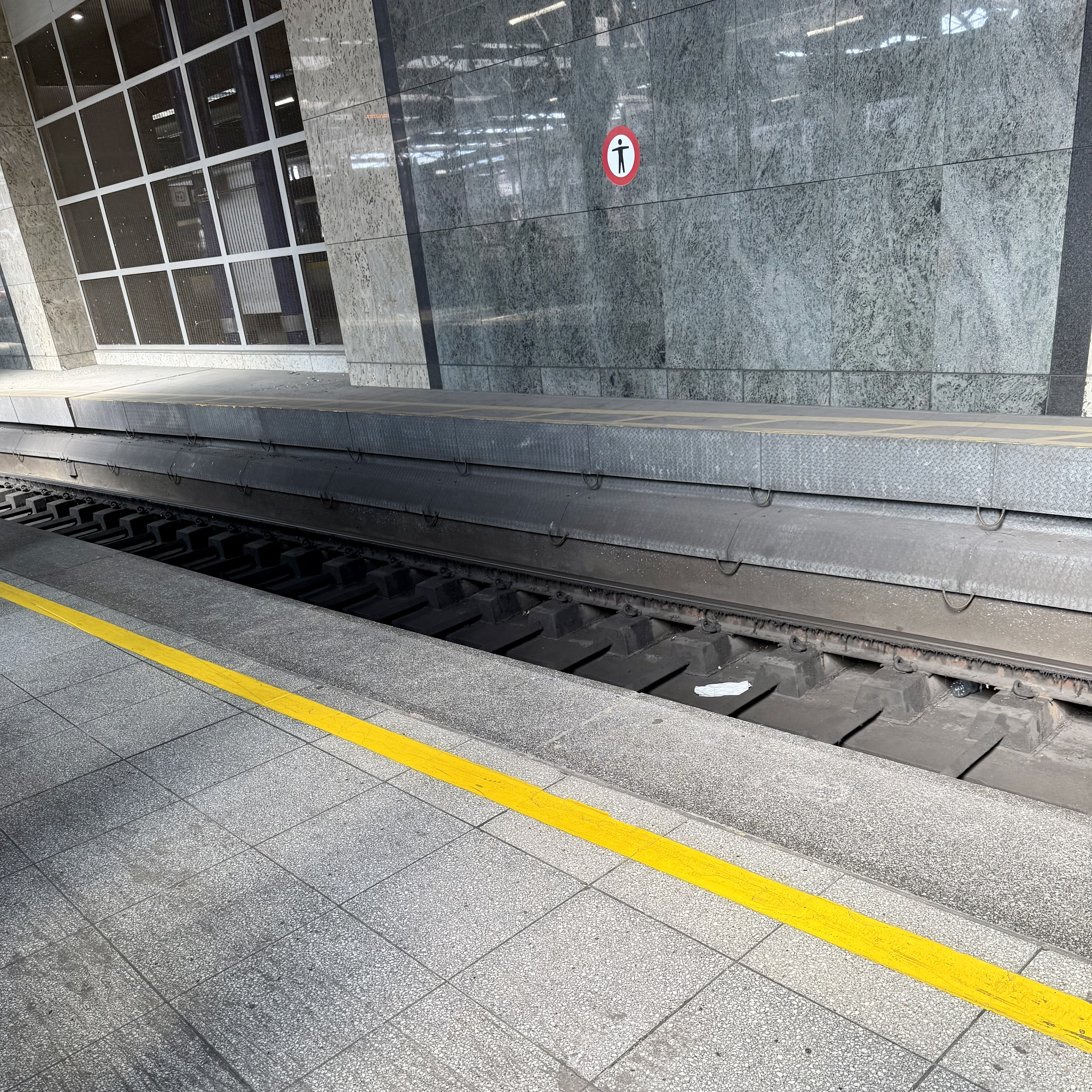
I’m on the last leg of a 900-mile railway journey. I’ll soon forget most of it, but not the man I sat next to under the Channel Tunnel. He was in his seventies, twinkling with fun. We chatted for two hours. He had been a professional musician all his life. Somewhere near the Kent coast, he told me he’d had a hard time finding his way through the station to where he was sitting, as he could not see very much. He explained he’d lost most of his vision a few years back. He wasn’t ready for a white stick; he didn’t want to be perceived in that way. He had asked a lady which platform the London train was from, and she’d pointed to a sign that he could not see, he’d sensed a bit of unkindness in her.
We talked about his music. I had a look on YouTube; he was surprised to know that his songs were on there. I told him if he uploaded them himself, he might be able to get some income from them.
He was proud of the cousin who was going to meet him. With difficulty, he found a photo of him stood in front of his house. I had an hour between trains, so I asked him if he’d like to follow me through the station when we arrived. He said “no thanks, I’ll be fine.” He was a proud man.
We waited for the carriage to empty. I made to carry his bag, but he wanted to do it. I walked ahead; he paused at the door. I told him how many steps there were and that there was a big gap to the platform. He passed me his bag, and I held my arm out to him as he stepped down.
The platform was teeming with people, all going in the same direction. I didn’t really know what to expect myself, as it had been ten years since I used this station. I offered my arm, but he said “you walk in front, I’ll follow your feet.” Despite that, I felt a hand on my shoulder a few times.
On the escalator, I told him it was the kind that has steps, not a slope. At the bottom, I told him when it was time to start walking. He told me he had nothing to declare customs-wise.
As we reached the arrivals area, I recognised his cousin from the photo. A nice-looking man a little younger than me, he beamed at us, recognising what was afoot. We shook hands, all of us, and I left them to it.
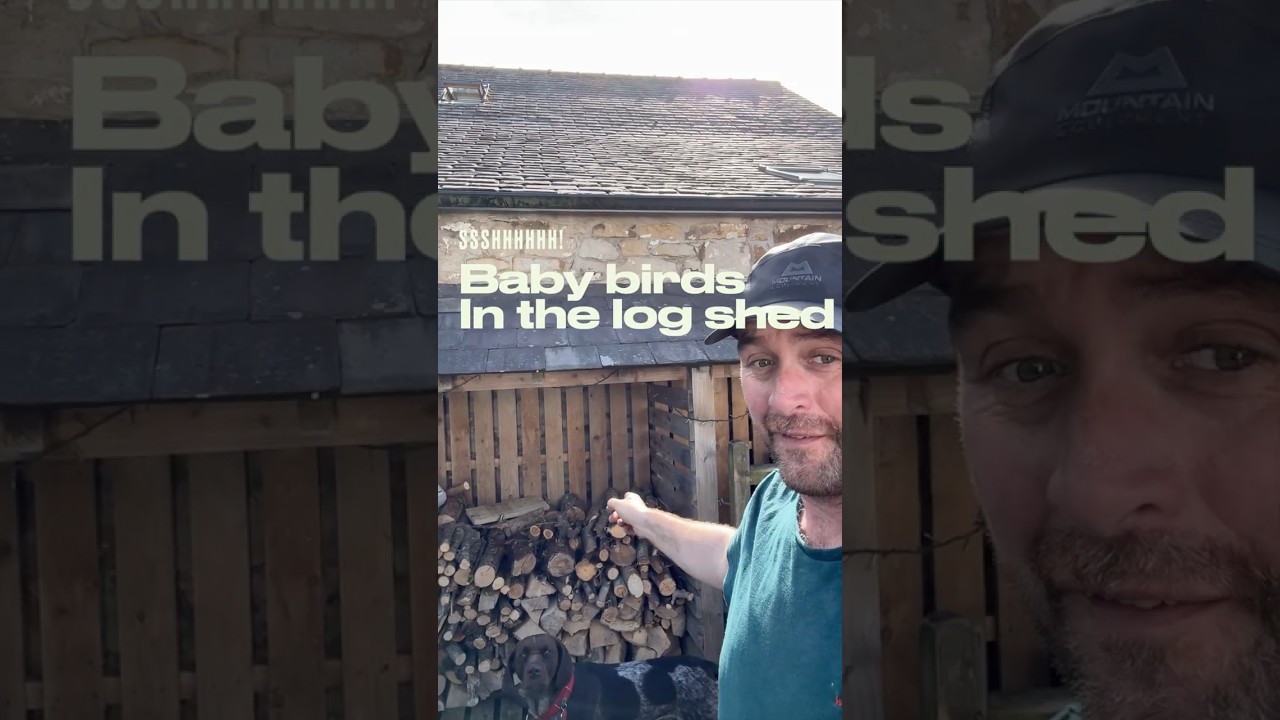
The wagtails chose our logshed. It’s right outside our kitchen door and we’re in and out non-stop. They must have priced that in and decided it was worth it. Perhaps they were more confident than their peers, or at least more able to balance the risk versus reward.
There was a cold snap in the middle of May. The heating was off for the summer, so I went to get some wood for the stove. I saw the nest, set in the air gap between two stacks of logs, full of tiny eggs. We decided we could manage without the logs after all.
As I say, we are in and out all the time, so I popped my head into the shed every day or so to see how they were doing. I missed them hatching, but soon enough there were five balls of black fluff with enormous yellow beaks and beady eyes looking back at me.
The mum and dad visited their babies about once a minute on average. I could see them through the window. They seemed to work as a team: one sat on the ridge of next door’s house keeping watch, the other flew into the nest with a beakful of long-legged insects. They were cautious, constantly scanning for danger. I guess there’s a lot of that: cats, foxes, bigger birds, humans. I felt like we were the least of their worries. I hope so.
One of them took a liking to the roof bars of my car, so I parked it alongside the shed for them. That went down very well. It had a white stalactite of approval running down the window within a day.
The logshed is built with two compartments separated by wide-gapped slats. On around day 6 of their lives, I popped my GoPro through from the other side and left it running.
The mum and dad were back feeding within 10 minutes. When I reviewed the footage, I could tell when they were about to arrive because the audiogram showed a spike in volume. The chicks could hear or sense the imminent arrival of a parent and ramped up their noise. They also seemed to be electrified at that point, their beaks thrust into the air, gaping open, demanding. The adults fed one or two chicks on each visit. They seemed to remember whose turn it was.
I noticed an adult flying away with what looked like a white egg in its beak and thought nothing of it. As I watched more footage, it happened again and I saw that I was wrong. One of the babies was fed, then turned around 180 degrees and presented its bottom to the adult before excreting a white sack straight into the waiting beak of the grown-up. The adult took it and flew off. I had to watch and rewatch that, and then do some research, but evidently faecal sacks are a thing. It makes total sense. The nest would soon get infested with parasites and attract predators if the waste were allowed to accumulate. Apparently, the parents also regularly eat it themselves.
On the 16th day, I noticed them as I came back from walking my dogs and took a quick photo on my phone. They looked different, expectant in some way. Later on, my neighbour asked if they had fledged, as he had seen several baby wagtails in his garden. He took these photos. When I checked, they had all gone. I was surprised how much I missed them, I kept checking the empty nest when I walked past.
I thought that was our bird drama for the year. Then the blackbirds moved into the polytunnel.
There were five eggs this time, much bigger than the wagtails’.
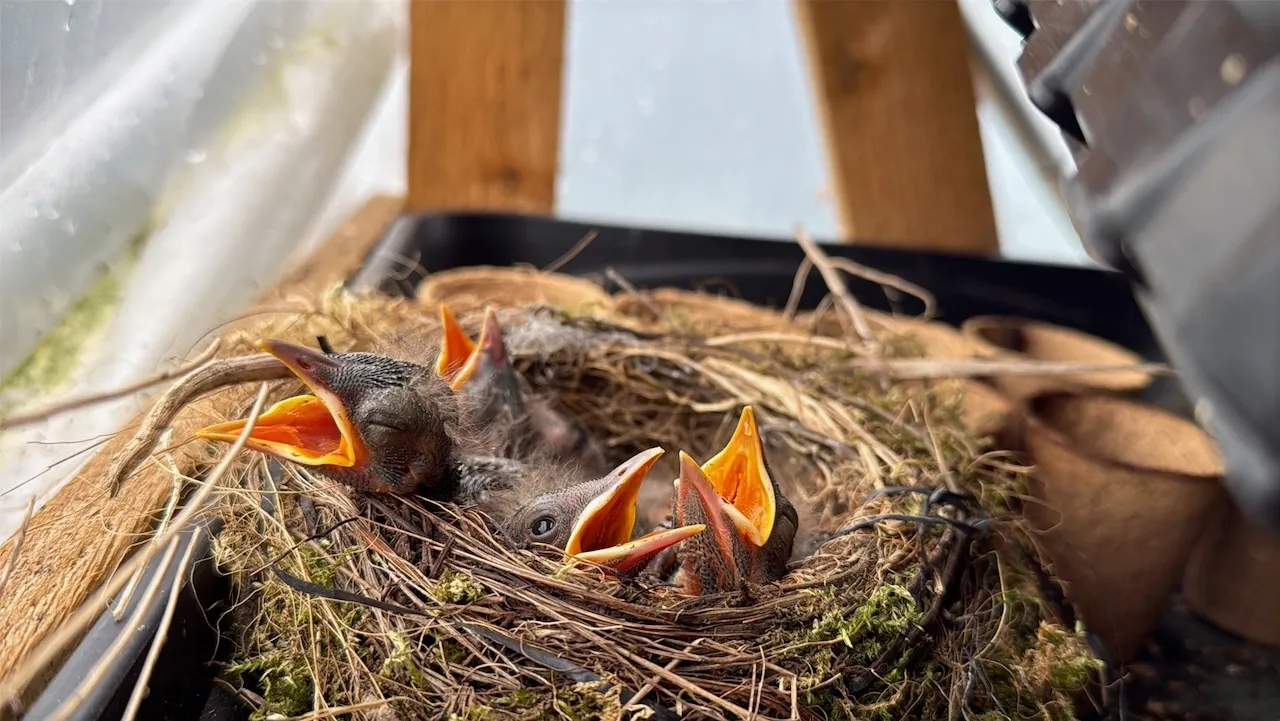
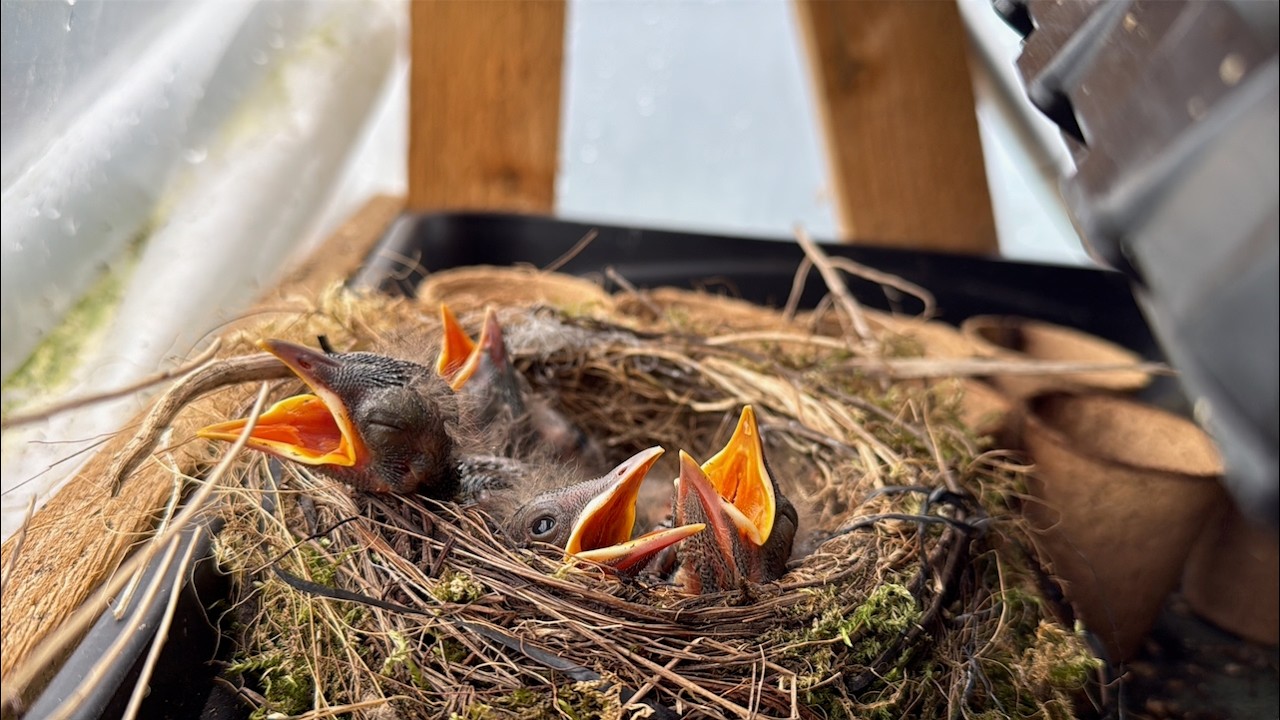
I grabbed a quick film of them whilst the mum and dad were away, you can see there were 3 eggs still to hatch. I left the GoPro pointing down at them from the planting shelf above and captured one of the eggs hatching. The babies looked like little aliens or dinosaurs. Huge bulging eyes that stayed shut. Wrinkly, see through skin. No wings yet, just stumps. They were unable even to raise their heads
I caught another noteworthy bowel movement, again it was taken away immediately by a parent. It was pure egg yolk, which actually makes sense considering where the baby bird had just been.
You can see their diet is also very different to the wagtails. The mum and dad are feeding them chunks of worm flesh in this clip. They are more aggressive, you can see the adult pecking the baby to prompt it to open its beak before ramming the food in.
After 6 days, they were unrecognisable – clearly now young birds with long yellow beaks, feathers and wings. Eyes open now, looking for the next meal delivery.
I noticed one of the babies wasn’t raising it’s head up for feeding. It was smaller than the others. It disappeared overnight. By the end of the 7th day, I could only see 3 babies.
By the evening of the 8th day, only one remained. There were no feathers or signs of anything happening. The parents were still feeding the baby. We set up a trail cam to monitor overnight and caught this rather overweight ginger intruder. We think he must have been responsible.
We kept the polytunnel shut overnight after that, the adult birds could still slip in and out under the door.
As far as I know, the little one made it. I had to go away for the weekend but my neighbour kept an eye on him. He had flown onto the tomato plants overnight and was gone within an hour. We haven’t seen him since.
I won’t forget these two families. They were tiny, frantic, filthy, vulnerable and completely committed to the job of being alive. With so many dangers, predators and points of failure, I found myself deeply respecting them. Without doubt, they put 100% effort into their lives. I’m not sure I can always say the same.
Dog walkers are always making grim discoveries. I was 18 when it happened to me.
I was with my terrier. I saw a small car in the distance. It was out of place, far from the nearest road.
I wandered over, curious. The windows were all misted up, the engine was ticking over. I could hear loud music playing. I circled around it, not getting too close in case it was a couple.
There was a garden hosepipe coming out of the exhaust. Someone had tried to seal it in place with red insulating tape. I took a step closer. There was a man in the driver’s seat, his forehead almost touching the steering wheel.
This was 1998. I had no mobile phone. I shouted “Help” and paused, holding my breath waiting for a reaction. There was none, nothing from the man in the car and not a sound from anyone else. I could not see another soul in any direction. I felt I had to do something. I pulled the hosepipe out of the exhaust. At least things could not get any worse now.
I tried the door handles. All three doors were locked. The passenger window was cracked open to let the hosepipe in.
I kicked the glass as hard as I could, connecting with the flat of my foot. Nothing happened.
I found a hefty stick. The window smashed to pieces the first time I hit it.
I reached in and unlocked the door. The air was hot. It caught my throat even though I tried not to breathe. I leaned across the man’s shoulders and unlocked the driver’s door. I walked around to his side and opened the door. He was cherry red, unconscious, floppy. He had been sick on his lap. He had no seatbelt on. I took his arm and pulled. I’d never been around an unconscious person before. The way he fell to the ground was disturbing – he behaved like an object rather than a person. He landed on his side. I rolled him onto his back.
I slapped his face gently. His eyes were fixed, unfocused. I gave him a few chest compressions whilst I thought about what to do. I’d never done that to a real person before. It felt horrible, violent. There was froth coming from his mouth, so I decided against any mouth-to-mouth.
The CPR wasn’t doing anything, and there was nobody else around. It felt wrong to leave him by himself. I knew if I went to get help, it would take too long by the time I took them to him. I decided to try and move us both closer to the main road.
I tilted the driver’s seat forwards and dragged his upper body back towards the car. Somehow, I bundled his torso into the space behind it. He was a bit bigger than me, so I couldn’t get his legs in. He ended up on his front with his face resting on some of the broken glass. As I put the seat back down, I felt resistance; I think that was his arm. The windscreen was still steamed up on the inside, and the wipers didn’t help. I didn’t want my dog cutting himself, so I kept him outside on the end of his extendible lead. The gearbox and pedals were different to what I was used to. I found first gear and let the clutch out, slowly, with lots of revs. I had to go about a third of a mile around a ditch to get towards the road. I was hooting the horn because I couldn’t really see where I was going. I noticed a flattened cardboard box on the passenger seat. It had once contained a car foot pump. I would read it later; it said “to whoever finds me.” The handwriting started off very neat but by the end it had faded to a scrawl.
I stopped just near where my own car was parked. A couple were just about to start their afternoon walk; they looked frightened. They soon realised I needed help and ran over. She was a nurse or a midwife; she was much better at the CPR than I had been. A small crowd started to form; someone must have had a phone, and a 999 call was made.
Within a few minutes, the ambulance arrived; they took over. The defibrillator didn’t make any difference, and after a while, they stopped; they put a red blanket over the man.
The police came. There was a sergeant in his 30s, plain clothes. He asked me to show a young PC the place where I’d found the man. The PC told me not to blame myself. Until he said that, the thought hadn’t even crossed my mind.
I gave my details, and they said I could go.
A few weeks later, a retired policeman from the Coroner’s office came to see me at my mum and dad’s house. He took a statement.
I had to go to the inquest. I went on my own. I found myself sat next to the man’s wife as we waited for it to start. As a sixth former, I didn’t really know what to say to a lady whose husband had died like that.
I didn’t read my statement as such. An official had a copy of it in his hand; he read it out as a series of questions that I could agree with. That was it; they said I could go; I never heard any more.
I’m 46 now. Every day, I still think about the car in the distance and the man inside it. It didn’t do me any harm, but my life was different after. I’ve carried on doing my best to do the right thing and not to look the other way. I’ve had some good adventures doing that.
If you feel you are affected by the issues raised in this post then please speak to the Samaritans, click here to visit their website or call 116 123.
I had a spare summer in between university and starting work properly in the new year. I needed a job; I knew I didn’t want to work in a shop or an office. I was intrigued by an old-fashioned-looking advert for a “driver’s mate.”
I was interviewed by the matriarch, a grand lady called Pamela, well-spoken, pencil skirt, heels, pearls, lipstick, good hair. She had married into the family who gave their name to the business. She seemed ever so slightly dissatisfied to find that this was her life.
The pay was £3.70 an hour between 7 and 3 and time and a half between 3 and 5. I was issued just the one liveried polo shirt; I got a bang of the previous wearer’s Lynx as I pulled it on.
I arrived early on the Monday. There was already a short queue of three guys lined up to clock in. They each found a small piece of card with their name on it and inserted it into the slot of a machine for stamping. I copied them. It felt a bit dehumanising and undignified. According to a sign, stamping someone else’s card would be treated as gross misconduct. Much later, in my petulance, I found that it made no difference whether you stamped your card or not; you still got paid just the same. They must have chucked the cards in the bin.
The other men seemed much older to me. I was 21; they were probably in their forties. I can still remember most of them.
Tony was one of the forklift drivers. His teeth were the right size, but his face was too small for them. Slender, just over 5ft tall. Leathery, olive skin. A salt and pepper handlebar moustache. Furtive, busy eyes. Oil-stained blue jeans. The configuration of his teeth and face caused a whistling when he spoke; it was not an unpleasant sound, though you could not often say the same for his conversation. I realised he was close to the bottom of the social hierarchy.
Reggie was the longest-standing driver. Probably in his fifties. Blonde, thinning hair but still enough of it to style with a comb. Red face, high blood pressure. Mouth set into a sneer. Angry eyes, belligerent. He had utter contempt for the firm and especially for the other drivers. He reminded me of a fox.
Malcolm – he drove the other forklift but only when needed. The rest of the time, he did short drops in one of the vans. He had a baby face, short, greying curly hair. I could never work out if he was a young-looking old person or an old-looking young person. He lived with his Mum. His nickname was Pigeon because he once shat himself.
The warehouse used to be in the neighbouring town. After they moved it, the owners let the drivers use the vans to travel over. The pecking order was such that Reggie drove. Another wagon driver would be up front, Malcolm and a few others used to ride in the dark, stinking back.
Flash – he was a nice guy. He drove the “N” reg Mercedes lorry, the largest on the fleet. I was to work with him at first. A family man, he’d started out as a driver’s mate like me and worked his way up. He communicated mainly through impressions of other people or phrases from TV shows. Every day, as he drove through the high street, he would look for a fat person and then declare it to be “A day of fat people” in absolute genuine amazement.
7am – stamp card.
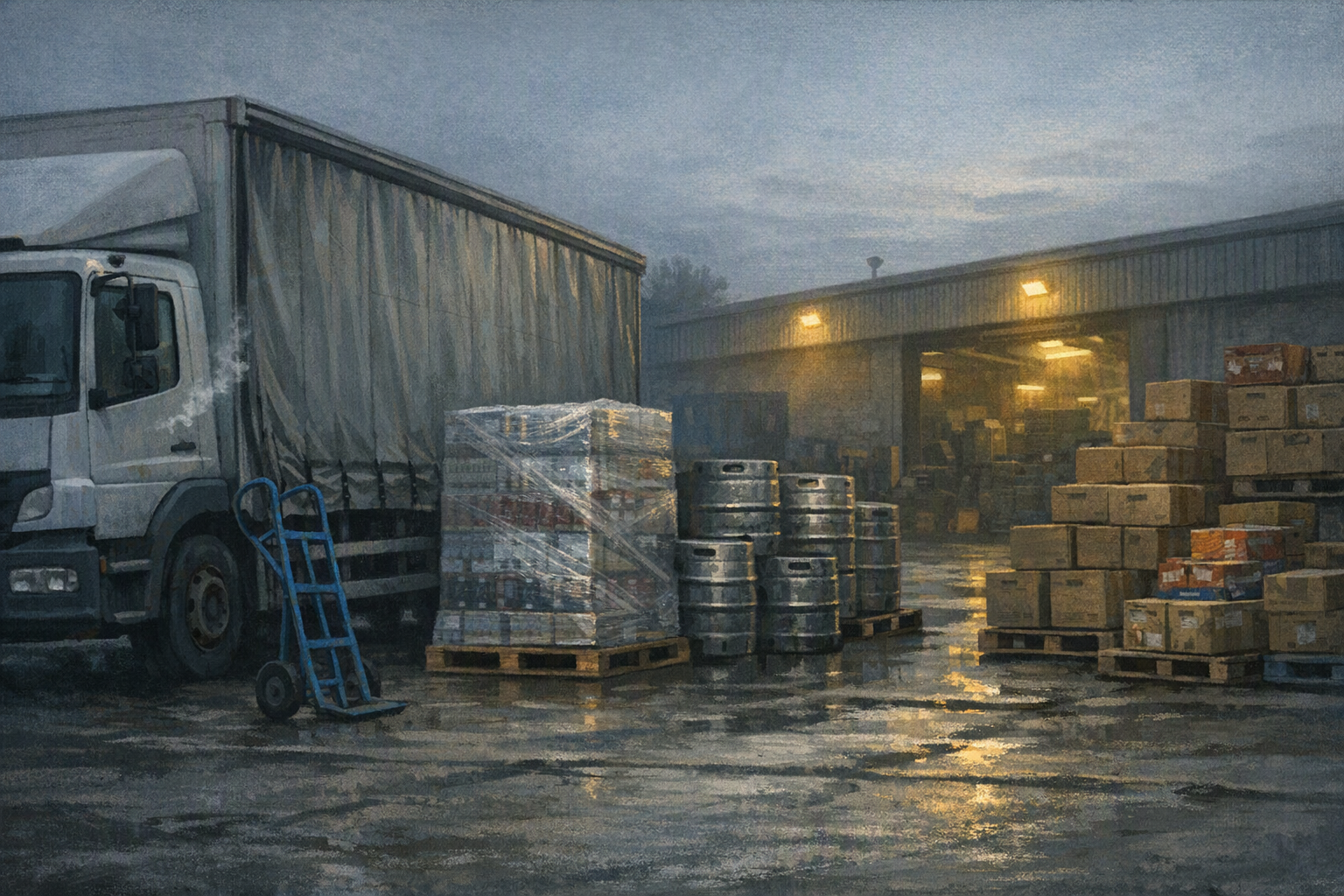
7am – 7:30 load the wagons. A mad half hour, both forklifts nipping in and out of the warehouse non-stop. Wagons queuing up waiting their turn. Drivers smoking fags, mates fastening curtains, checking paperwork, lifting cardboard boxes of crisps and pork scratchings.
7:30 – head out for the day. You could be going anywhere within the county or the two either side and even into London. The drivers knew the routes. Conversation was sparse.
On arrival, the driver would try and park as close as possible. They would go in and find the licensee. I would open the sides or the back and start loading up a sack barrow.
A load could be anything from ten aluminium barrels of beer to a slab of coke cans and some crisps. In exchange for cash, the stock would be rotated in the cellar, keeping the fresh to the back.
Most landlords would offer us a pint, both of us.
We ate lunch in between drops.
2 p.m. onwards – arrive back at the warehouse. The next day’s orders were waiting for us on clipboards.
The driver found their favourite spot of floor and stood still, calling out the orders in batches of what they considered the mate should be able to grab in one go. It was a memory game, not only of what had been called out but also, where it was stored.
We used blue sack barrows, like a large capital L. They had pneumatic tyres and a hook halfway up the back that you could drop over the lip of an 11-gallon barrel. If you were good, you could get two 11-gallon barrels side by side on the bottom, and another one on top.
They sold wine as well. There was some sort of unspoken collective trauma about that because now, only an actual manager was permitted to select wine and hand it to the driver.
3 p.m. – that was it. Each driver had created an island of pallets, one for each destination. Produce all cling-filmed into place. Clipboard laid on top, ready to go.
For reasons unclear, we all had to hang around for another two hours, for which, as I said earlier, we got overtime.
Almost everyone sat in the bait room drinking cups of tea, eating gone-off snacks, chatting rubbish. It wasn’t really my kind of thing. After a while, I slipped away and found myself a bit of a den in amongst the produce where I could sit and read my book.
I got paid in cash for the first two weeks. Something to do with not wanting to go to the trouble of setting up a bank transfer until I’d sunk or swum. One of the office girls used to fetch it down for me every Friday in a little envelope. A small handful of notes and a few coins. Tony always managed to be there when the girls came downstairs. He snatched the envelope from me, pressing it to his nose and inhaling as he asked her, “Has that been in your pocket?”
I gather he’d once been caught sniffing their stuff upstairs; he wasn’t allowed in the office anymore. He told me it was because he’d wiped his knob on the lady owner’s telephone in relation to some dispute or another. He talked a lot of nonsense. He was fond of reciting “Mary had a little lamb” limericks; they were funny the first time.
It should have been quite a jolly, happy place really, but it wasn’t. The owners were the second or third generation; there was no evidence of any passion for the business. I got the feeling they were trapped. There was a permanent cloud of decay and gloom; it was clearly not going to last long into the new century.
After a few weeks, I started to notice extra items being loaded. A pallet of cans of coke, a couple of barrels here and there. I didn’t say anything. I realised some of the drivers were making a bit of extra cash. It was a shame, but I guess they felt it was their way of correcting their petty grievances. The owners must have known about it.
I knew it was time to move on when 9/11 happened. There was no internet on mobile phones then, so it was a case of turning on a radio and listening. It had started to break as we headed back into the yard that afternoon. I was horrified; nothing like this had ever happened in the world of my 21-year experience. Nobody else seemed affected or even particularly interested. They carried on talking about tits and moaning about the firm as I sat in the cab of a parked lorry listening to the world changing.
I’m neurodiverse. I am oblivious to many things that stand out to typical people, but yet there are other, almost invisible streams of information that shout at me.
People would say I can’t read the room. But that’s not true. Reading the room is addictive, narcotic, exciting; I love doing that. Computing how to behave, how to stand, where to look, what facial expression to adopt, what’s safe to talk about—that’s hard. But I don’t complain; I’m lucky. I’ve learned about myself.
On the 0802 to Birmingham, I was hyper-aroused. Trains can be chaotic, dramatic, bursting with vignettes if you’re curious enough to look.
A man in his thirties, tattoos around the side of his neck and across his throat. Four-five days of stubble, a shaven head. Grey tracksuit bottoms, baggy, dirty. No name trainers, white socks. 5’7 or so, about 10 stone. Angry, very angry. Also, afraid. Black rucksack on his back, one strap only. A cheap rucksack, thin straps; the black fabric had a white/grey tinge to it. Stuffed full, the fabric drum tight. Carrying/dragging another suitcase that came up to the middle of his thighs. Walking quickly, jerky, stabby movements, his eyes working, staring through the electric door into the carriage beyond, scanning for what? For who? As he reached me, I saw he also had an extendable dog lead with a small, black bulldog on the end. The lead stretched taut, the dog an unwilling passenger, ears back, tail down, front legs braced forward.
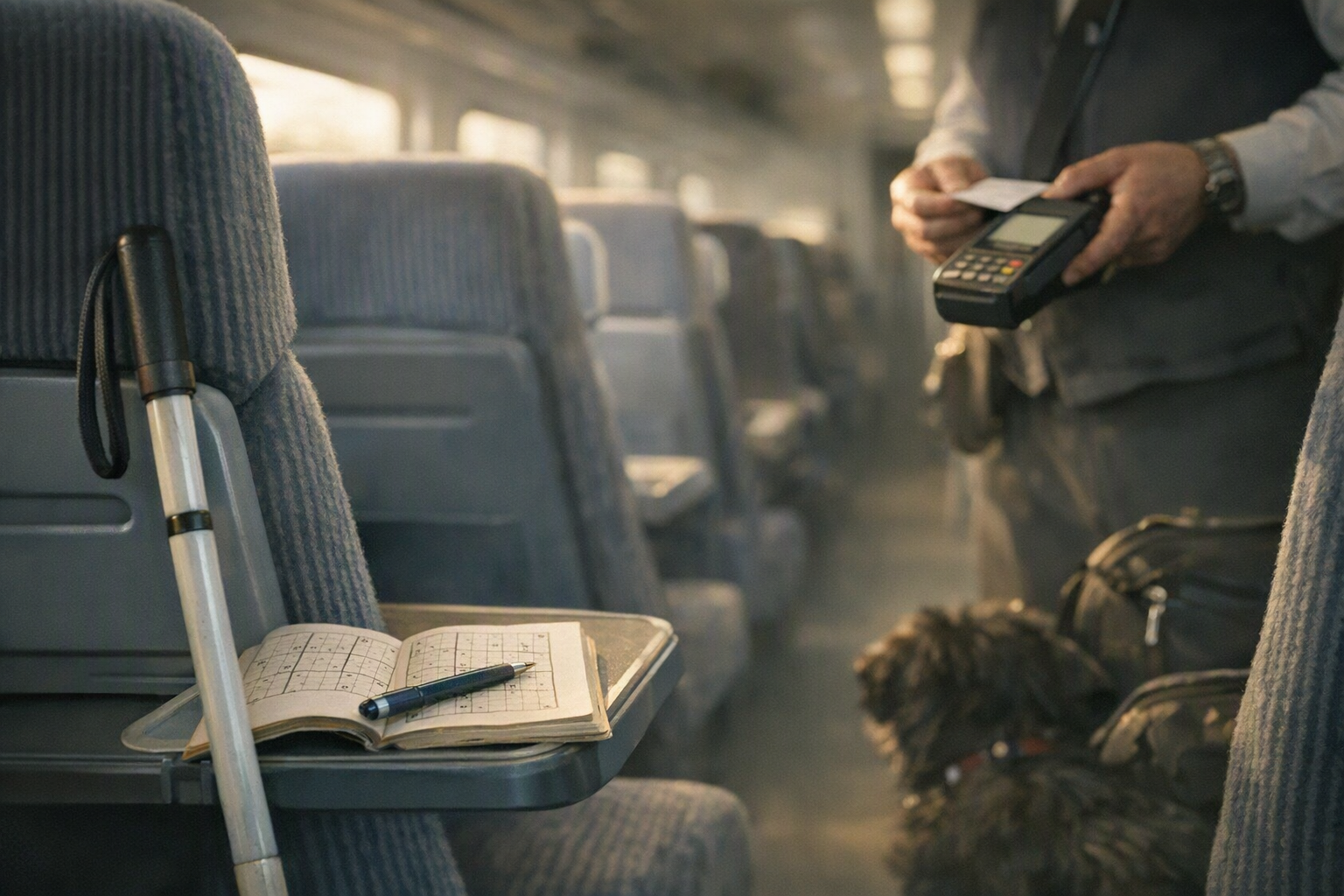
You get a fresh cast at every station. I was watching. The tip of a white stick flicked left to right, left to right, coming closer to me at less than a walking pace. The movement— deft, skilful, like how a bricklayer’s trowel becomes a part of them. The stick belonged to a woman; I could see slim legs wearing grey tights. Suede boots up to the knee, a black skirt with a cardigan. Three rows in front of me, she stopped next to two empty seats to her right. She stepped into the space between the seat cushions and the back of the row in front, her face pressed up to the feeble LCD display that tells you the seat number and whether it’s booked or not. She was confident, independent, far from helpless. An undertone of defiance.
A second lady followed her into the space. Older, sixties maybe. Grey hair. Kindly, maternal, a bit worried. Speaking to each other, not sitting down yet. They made no eye contact with any of the other passengers who were looking their way. Something about the angle of the younger lady’s shoulders and a little nod of the head told me she was the decision-maker. They sat, the older lady in the aisle. They just had handbags, no suitcases. I could only see the older lady now; she too had a white stick, she folded it away into her bag. She held her iPhone to the tip of her nose, took it away again, and took a small, black microscope from her handbag. She held it between her eye and the screen of her phone; it looked uncomfortable.
Another station, more new faces. A lady, late fifties, arrived from behind. Sensible, sensible shoes, a calf-length dress, a tote bag. Straight grey hair. Glasses. She was reading off the seat numbers to her left; she slowed as her peripheral vision told her that her seat was taken. She slipped into the seat in front, took her phone out, and shuffled around getting the right app open. She looked back and forth from the phone to the seat numbers, but only for a second. Her mouth set into neutral; a decision made, she sat where she was. Took out a Sudoku book on sand-coloured paper; a biro scratched away at the pages.
A male voice, ever so slightly louder than the background chit-chat, confident, authoritative. Coming towards us. He had found the right volume and cadence of speech to switch his passengers on; tickets and screens were ready and waiting. He stopped at the pair of ladies, studied the screen of the older lady, and asked if there was a pass to go with the ticket. She rummaged. An arm appeared from the window seat, clutching a plastic wallet. The older lady said they were not sure if they were in the right seats. Screens checked again. The guard looked back over his left shoulder, “One of you there, and the other where you are.” But this wasn’t an instruction; his voice was soft, unthreatening; he was just explaining. He said he would keep an eye out, and it would be fine. One of the seats had been booked from the station before anyway. The other lady raised her head from the Sudoku book and said, “Oh, that was me actually, so don’t worry.”
I was so invested at this stage; I gave her an involuntary beam, so did the ticket inspector. Something, I don’t know what, I could see no faces, but something told me that the passengers around me had all been holding their breath a little; a millisecond of silence ended, the tension burst with this release of kindness.
I felt the familiar prickling in my eyes that comes with shared emotion; I felt good; I was amongst kind, sound people; we had all shared a little moment together on the 0802.
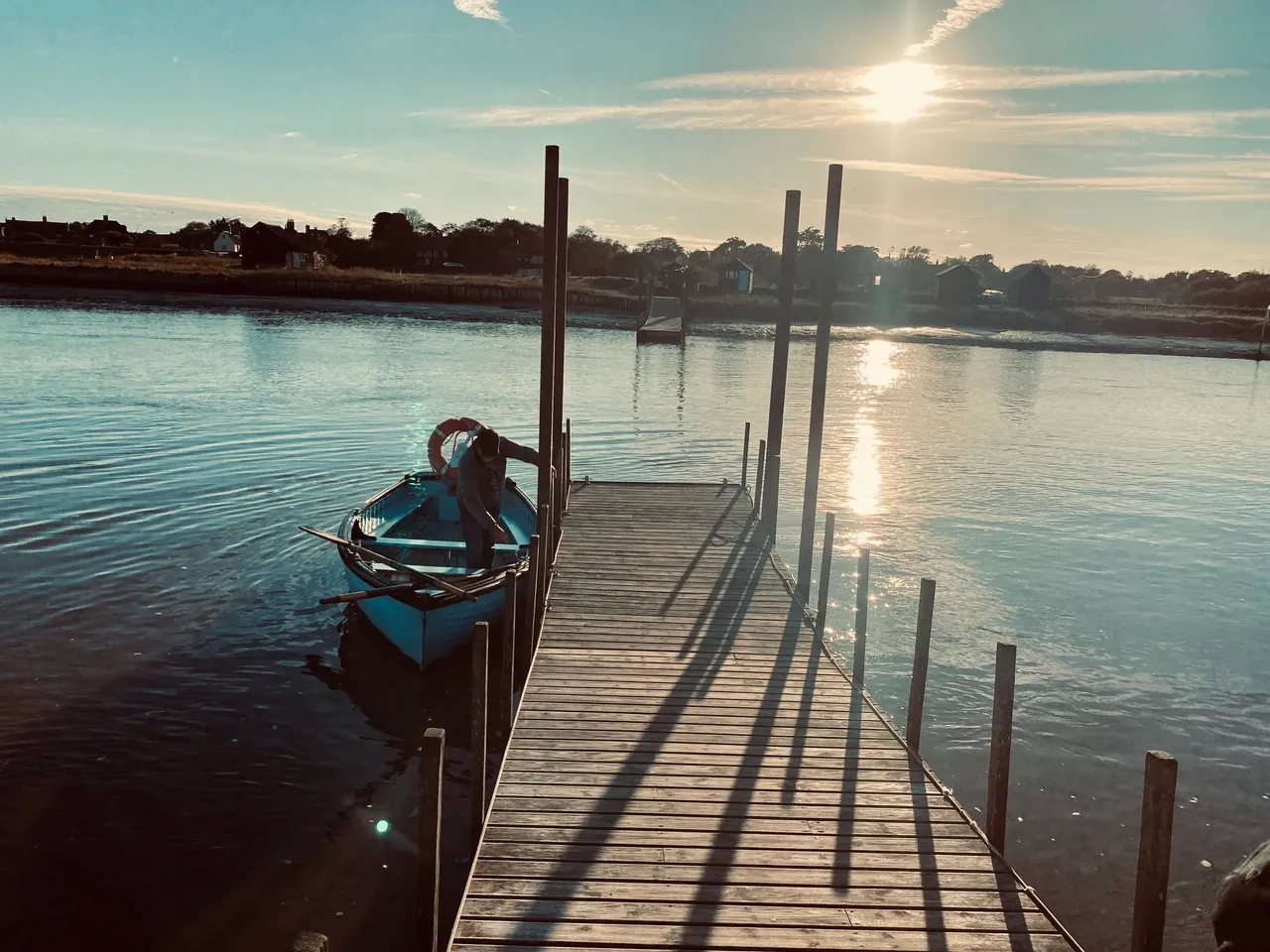
It’s a 100ft boat crossing from Southwold to Walberswick, a fine alternative to the 1.3-mile walk around via the bridge.
We finally did it on Monday.
The ferry is a large rowing boat operated by one man who rows from the bow. A sign on board says ‘Maximum 12 passengers.’
You reach it via a wooden jetty leading down from the road. Another sign instructs passengers to wait at the road until called forward.
So we did that.
The ferryman rowed over from the far side to collect us, and congratulated us on obeying the sign as he tied up.
He was about 60. Wiry, tanned, and with a twinkle in his eye. He had the air of a part-time poet.
He was very confident as he told us how to step down onto the boat one at a time and where to sit. I was wondering when to pay, but he had his patter off to a T as he said, “May I take your fares now, please.” It was £2 each.
He pulled away. I asked him how many crossings he does a day. He said they do a four-hour shift and that can be up to 40 crossings. We were impressed.
My mum remarked, “You must be fit.”
“Not really,” he said. “But you do need a certain amount of low cunning.”
I processed his words, wondering what he meant. He was reading my face well, and he explained that you have to be able to judge exactly how to position the boat depending on the tide, wind, and load.
As he spoke, he angled the bow upstream of the landing stage – what kayakers call a ferry glide. The current carried us sideways across the harbour while he maintained our angle with subtle adjustments.
He added that he had to make 32 crossings whilst the harbour master watched before he was permitted to work the route.
I noticed a small outboard motor on the stern with a life ring hung over it – clearly not required under normal circumstances. I asked when he uses it.
“It can be useful sometimes,” he said, offering nothing more.
As we approached, he angled the boat further into the flow. The oars came inboard and the current laid us alongside the landing perfectly. All without breaking his chat.
Two quick flicks of rope and we were tied off. He helped us out, steady and kind.
We arrived at Bardentarbet Pier just after midnight. I pitched my tent behind the car. Nick slept at the wheel with the seat back. By 5am it was light and the midges had already decided to choose violence. They attacked my face the instant I unzipped my tent.
Chunky, rough cobbles covered the beach between the road and the sea. Unfortunately, we put the boats down in the diluted liquor that was oozing out of a bloated, dead sheep. We hastily sidestepped onto clean ground.
We took it in turns to take the car a mile back the way we had come for a final porcelain poo.
As we shuttled back and forth from the car to the boats, I found a pair of Nikon binoculars in a see-through Lomo dry bag. They were compact, weighty and of very high quality with a metal body and glass lenses. They had been carefully sealed in the bag. Surely only another kayaker would have dropped them there. I stowed them safely out of sight in the car planning to try and trace the owner at a later date.
We paddled off, aiming directly for Tanera More. I’d read about it already; it was said to be privately owned and protected by security guards. We took a look at the settlement without getting too close, continuing clockwise.
A shiny-looking Land Rover Defender appeared to keep us in sight as we rounded the corner. We avoided that and found a nice secluded midge free beach where we could brew up and have our breakfast.
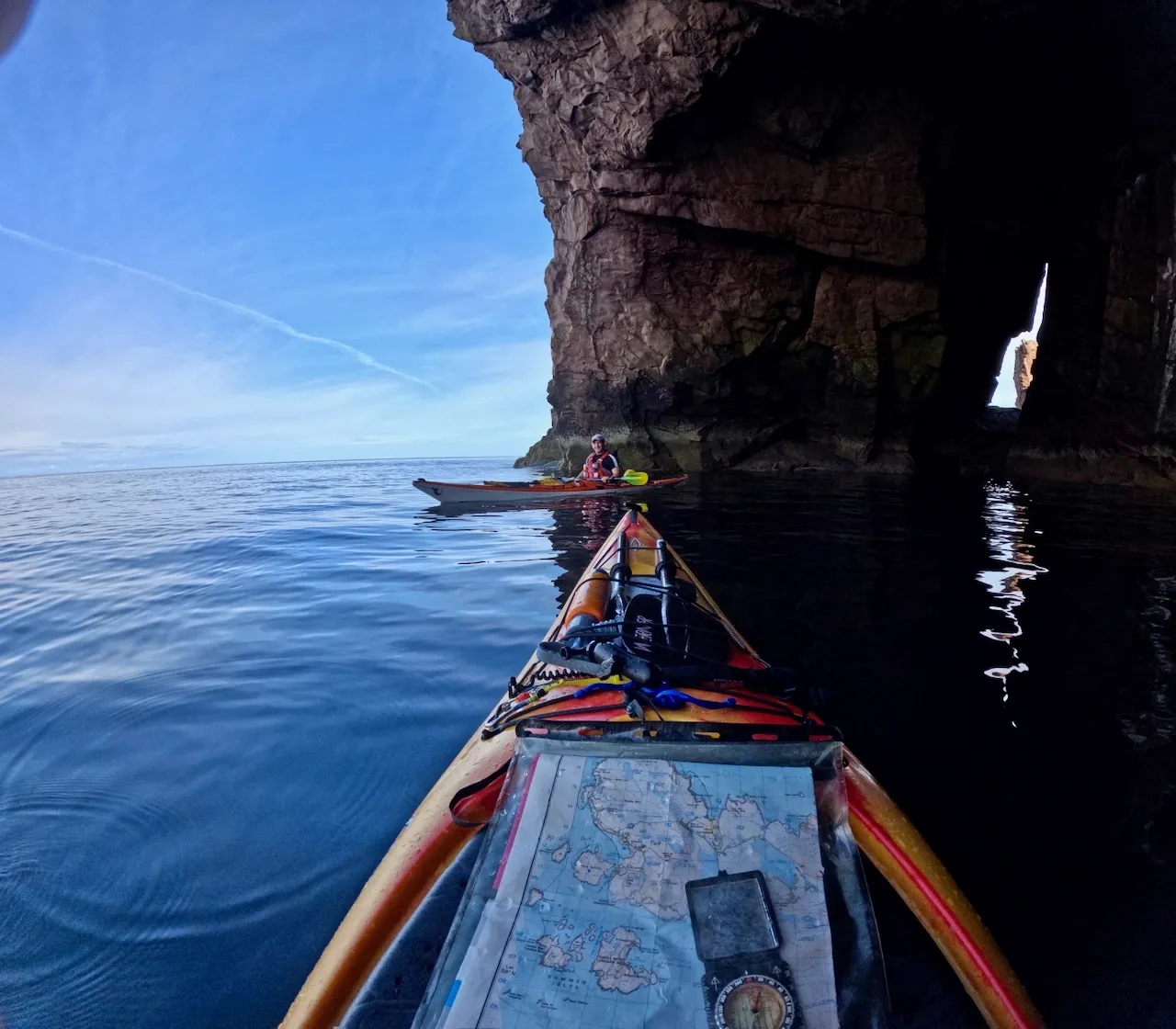
We paddled about 30km circling the islands, paddling into caves and getting a feel for the area. Two or three dolphins breached nearby. It was pretty well flat calm with sunshine all day, we had been very lucky.
At just after 4, we settled for a scrappy, rough campsite on west side of the uninhabited island Tanera Beg. We had a dodgy carry-over of more slippery cobbles to get the boats clear of the high tide mark. What had looked like flat, green grass was actually six inches or so of undergrowth, gorse and heather. It was flattish. There was plenty of driftwood though and no “neighbours” to offend.
We’ve executed this drill many times now, so we were all set with tents pitched and settled in within 45 minutes.
Personal admin is of critical importance on these trips. We stripped off to our undercrackers and wobbled our way back into the sea. I’ve got some travel soap that seems to be ok with salt water. I used my microfibre travel towel to dry off, a blast of Lynx and I was ready for my clean, dry clothes.
Nick is the designated firestarter but I helped gather a respectable pile of washed-up fence posts, pallets, branches and twigs. Dinner for me was an Uncle Ben’s rice and tinned salmon followed by a nice cup of tea and a chocolate bar. Nick’s more of a boil-in-the-bag man.
The next bit is my favourite.
Lighting the fire and pitching into some tins of beer. Guinness or Adnams Ghost Ship for me, Shipyard for Nick. I don’t know how many, definitely too many. Beer, fire, shooting stars, satellites, pretty amazing to think the closest other humans were several miles away and separated by water.
We had a fair night’s sleep and awoke to a midgey breakfast, porridge for me, boil in the bag all-day breakfast for Nick. Nice cups of tea.
If you’re eating, sleeping, and bathing in the wild, you’ve also got to have your daily Richard III wherever you may be when the need arises. I used to worry about that, but these days it’s no issue at all. I take a little orange trowel down to where the sea meets the sand, dig myself a hole about six inches deep. Ideally, just in front of a rock or something I can brace my back against. Trousers and pants off, bombs away, bury it, and then waddle into the sea. Once you’ve wiped your arse with wet, soft seaweed, you won’t look back. It’s very nice. Very kind on the anatomy. A quick sluice of seawater, a spot of soap, and jobs a goodun. You don’t want to cut corners with these drills, the last thing you want is nappy rash.
Welcome back if you skipped the last paragraph.
We got underway. Heading south east towards Horse Island. On the way, Nick, with his eagle eyes, saw dolphins breaching about one kilometre away. I don’t tend to notice these things as I’m a) short-sighted and b) map reading.
We wouldn’t dream of disturbing wildlife, but as it was, we were headed that way.
Twenty minutes later, we met the dolphins. There were about 25 of them, arcing out of the water in twos and threes, playing, enjoying their athleticism. For fifteen minutes they crashed in and out of the sea, sometimes as close as ten feet from me. I have rarely felt quite so alive. I could smell them. I was being lightly splashed as they re-entered the water. They created a wall of sound with their snorting, breathing and smashing into the sea. I held my underwater camera beneath the hull, hoping to capture it.
We both managed a bit of film which I have edited together here.
As we ate our lunch, the coastguard transmitted a missing person bulletin on VHF channel 16. A lady, in her sixties, on her own, out in a kayak, not too far from us and overdue back to her family. We know each other from our time in the police, so we both mentally switched on. When we peered into the distance, we saw a sea kayak slowly heading our way with a grey-haired paddler. Surely not!
The paddler had seen us; at 30m, we realised it was a man, not the missing person then. He stopped for a chat. Straightaway, he was two leagues better than us. His composite sea kayak was well used, patched in places but of top-notch quality. His gear was high spec, slightly sun-bleached. He had a dry suit, we were in t-shirts. He was about 70. We made him a cup of tea and swapped war stories of kayaking trips past. He was humble, a soft East of Scotland accent, clearly a highly accomplished paddler.
He very politely and diplomatically put it to us that we were a bit risk-averse and challenged us to up our paddling game. This was a breath of fresh air as most people we meet tell us we’re going to die!
He showed us some of his kit, I noticed he had a medium sized plastic bottle with the bottom cut away just in front of his seat. I’d had to make myself one of those once when I needed to empty my bladder, but we didn’t comment on it. He proudly showed us a pool noodle that he had modified as an aid to self rescue in the event of a capsize.
As an aside, I mentioned the binoculars we’d found. His smiling face broke into a beam, he explained that his was the car next to ours back at the pier. He had set off a couple of days before us. He had lost his binoculars but did not know where and had been emptying his kayak and retracing his steps totally unaware that they were left on the beach where he had set off. He described them to me, this was unnecessary as I was already totally convinced he was a genuine person. I took a note of his address and asked for his phone number so I could confirm he would be around, these were valuable and would need special postage. I found it quite charming that he did not know his number and his phone was safely powered off inside a dry bag in the depths of one of his hatches as he got it out and looked it up for me.
Mr W told us the best place to camp. He went north, and we carried on south to the beach he recommended.
This was a proper, perfect campsite. Actual flat grass, sandy beach, bountiful firewood, and even a fireplace. Just before we turned our radios off for the night, we heard with relief that the missing lady kayaker had returned in one piece.
As the tide fell, Nick noticed the remains of some wood structures and rocks that we surmised were to hold fishing nets to sieve the small bay’s catch from the retreating sea. We thought about those who had gone before, sat around a fire on the exact same spot as us, bellies full of fresh fish.
When the sun settled, the midges came out. These were the worst midges I’ve ever experienced in my 46 years.
I’ve spent a lot of time in Scotland. This was the midge apocalypse. Words cannot convey how serious this was. It was not a case of the air being thick with them. The air was them. Every inhale sucked hundreds of them into my throat and lungs causing sharp coughs. They filled my ears with tiny, whizzing screeches. My eyes itched and wept involuntarily. We both had mosquito nets, but it was unbearably humid and unpleasant underneath them. My snood was literally a lifesaver. I used it to cover my ears and mouth, I think I would have gone insane otherwise.
We both had to abandon our beers and head into our tents. It was that bad.
Overnight, my eyes started discharging sticky pus. My eyelid muscles were not powerful enough to open, so I had to manually pry them apart with my fingers whenever I needed to see anything.
Things were not much better the next day, so we packed up and fled into our boats. Midges never seem to follow us more than 20 ft or so out into the sea.
We headed back north, taking a meandering route around the northern summer isles. More arches, caves, and dolphins.
We discovered a cow-sized dead animal floating in a little cove. Probably a whale. The sea was getting lively, so we pressed on for the commercial campsite at Altandhu.
All the other campers had gravitated towards the upper pitches, near the road. We were the only ones to arrive by boat, so we had the lower beachside terrace to ourselves. We paid the man and luxuriated in lovely hot showers.
The pub next door (Fuaran Bar) was busy. They were serving food but told us there were no tables. But there was room in the bar. And they were doing takeaways. So we had takeaway fish and chips at a table in the bar. And many, many pints.
The last day was easy, a 6km paddle back to the car and home.
When I got home, I sent a text to Mr W and he gave me his address. I carefully wrapped his binoculars in bubble wrap and put them in an old amazon box, they were sent special delivery. He sent a very gracious thank you, his offer to pay for the postage was declined and we both said we would meet up if we’re ever in each other’s neck of the woods.
When I think back on this trip – the dolphins, the apocalypse midges, the perfect campsite – what stands out is Mr W. We only spent an hour with him, but his influence was lasting. He challenged us to be bolder. He shared his best campsite. He showed us a little into our future being decades older than us and still in the midst of our shared hobby. And somehow, through pure chance, we were able to return something valuable he’d lost. That felt right.
I’ve enjoyed visiting my in-laws a lot more since they moved to the countryside a few years back.
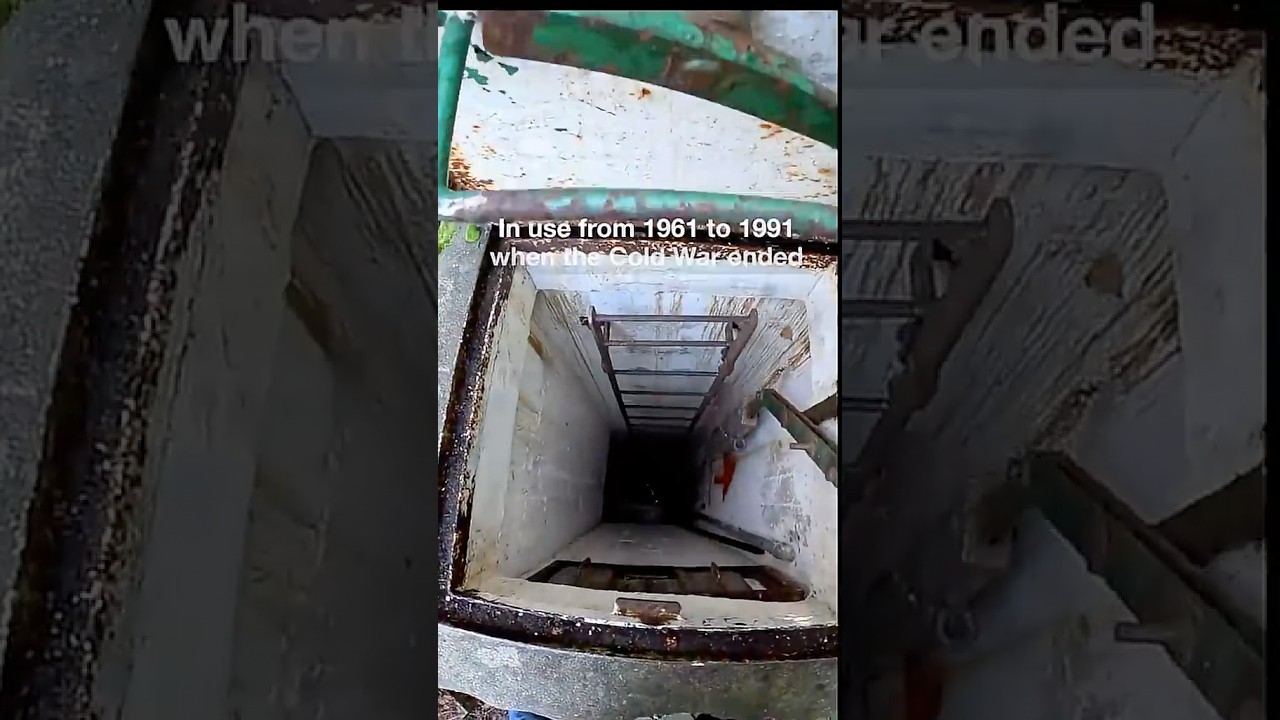
Whenever I walk my dog from their place, I pass a Royal Observer Corps Cold War monitoring post. It’s been decommissioned since 1991. Sat in the corner of a farmer’s field next to a busy A road, you wouldn’t really know it was there.
There’s space for a couple of cars just off the road. Most people who park there have no idea how close they are to a Cold War time capsule. Takeaway wrappers, NOX bottles and a sadistic-looking Richard III discourage you from taking the narrow path that leads up to it.
There’s a concrete box rising from the ground with three steps built into it. A green metal lid sits on top. It has two hasps, one on each side where it would once have been locked, but they’re long since cut. It still opens easily, well designed with a counterweight, though these days it makes a painful graunching sound.
Under the lid is a white-painted, concrete-lined shaft with a metal ladder set into the far wall. It goes down about fourteen feet into damp-looking darkness. I went down for another look on Sunday. This time the lid wouldn’t stay open, so I let it close gently. There was still light getting in, so there must have been air.
I climbed down halfway; it was getting dark. My imagination ran away with me, wondering if there was anyone waiting for me down there. I held my breath and listened. When I switched on my torch, I could see where I’d be landing, so I carried on.
At the bottom there’s a toilet or store cupboard on one side and the actual bunker on the other. Only a small space, about the size of a single garage. The walls were once white but are now covered in graffiti. The floor was a mess of smashed-up wooden pulp – presumably what’s left of the doors and shelves. It had a musty, dirty stench. Surprisingly, I could still hear every passing vehicle on the road above. I’d expected silence.
I looked up at the metal flange on the ceiling that once held the monitoring equipment. Shining my torch into it, I saw a pipe running up to the surface.
There would once have been a wall of communications and recording apparatus. Now there are only a few wires and holes where it was ripped away when the post was decommissioned.
A minute or so was plenty. I appreciated the fresh air and sunlight when I lifted the hatch and climbed out.
I find it fascinating that there were so many of these things – one every eight miles or so, enough to triangulate any blast and then measure the fallout afterwards. They were staffed by local volunteers; once a month they’d unlock the hatch and descend for training. In a real activation, three of them would have spent up to two weeks locked in, monitoring and sending signals.
Most have been sealed up or filled in, some lovingly restored. Others, like this one, are probably getting a bit dangerous thirty-four years on. I don’t think I’ll go back inside again.
It’s about 7 miles cross country to the closest viable pub. So I don’t go there very often.
There was football on. A group of lads stood 2 deep at the bar, making micro adjustments so they could maintain vision of the TV on the far wall.
A bulky couple sat on bar stools, not watching the football. Her top was tight, dark in colour. It didn’t quite reach the waistband of her blue jeans. She had her back to me. I wondered whether she could feel the draught when the door opened. Maybe not. He wore a plasticky looking fleece, the zip only went down to his sternum. His head was square, his torso oblong. He reminded me of a child’s pencil drawing of a man. A favourite uncle perhaps. They were nice people, kind faces, she reached a friendly hand towards my dog. He wasn’t feeling very confident, or maybe that was me projecting. He ignored the hand and pressed his hip a little closer to my calf, his tail not only down but folded neatly underneath his belly. He much preferred the journey to the destination.
I felt a bit the same so I ordered a pint of Wainwright and made my way outside. It was dark and about +1 degree but still preferable.
I split up the remaining treats and put small pieces on my knees and the surrounding benches whilst William licked his lips. “Go on then”, he hoovered them up in adoration.
The lady from the bar stool walked over. She had a cigarette in her hand as she came out of the door. She watched me and my dog for a few minutes then asked me about him. He didn’t much care for the conversation, his spine arched a little, I could tell he was feeling the cold. I tilted my torso back a bit and made my thighs into a lap so he could climb up and then wrapped my arms around him as we spoke. He felt lovely.
The conversation started to falter and I turned away. A thudding sound made me jump, the poor woman had missed the bench with her backside and was laying on the floor. I stood up to help, she was up instantly, face flushed. We were both embarrassed, she said she was ok. We laughed nervously, she finished her cigarette and went back in.
It was her partner’s turn for a fag. They must have been taking it in turns so they could keep control of the barstools.
He was the more extroverted of the pair. He immediately commented on the falling over that had just occurred, he said “the dog walker saw it”, reporting it back to “him” in the third person.
He told me about his dogs. Over ten of them. He’d always had dogs. As a child, his Dalmatian once found a whole bag of pound coins. And ate them. He said he had to follow it around the yard with a hosepipe the next day, washing the shite off of them. He gathered them all up. His grandad didn’t want them back after what had happened, so he spent them in the sweet shop.
My lift arrived, and I left the remaining questions behind.
It must have been the trace of urgency in her voice that caused us all to hold our breath and look over when she said “manager to checkout three please.” The poor girl seemed a little self conscious as she held up a dripping ten pack of Pepsi. “I need another one” she said, to nobody in particular.
A guy with a ponytail and a heavy metal T-shirt stepped out of the queue “I’ll grab one?” He struck me as someone who worked there. His partner was having none of it, she muttered something to him and he meekly resumed his bag packing.
A skinny man approached. He was in his thirties, wearing a collared shirt. I took in his black earpiece attached to a walkie talkie via a curly cable. I nodded at him in approval. He had a brisk, efficient energy about him and he did not reciprocate. I sensed a feeling of relief all around me – earpiece man would sort this out in no time.
He spoke into his radio and tilted his head a few degrees listening to the reply. “Sorry that’s the last one” he said.
All eyes turned to the customer and the cashier. The cashier looked embarrassed. A gruff voice from somewhere behind me said “give her a discount.” The cashier raised an eyebrow and turned to the manager “30 percent?” He gave the slightest of nods.
The cashier turned to the customer, a rather genteel looking lady. The customer paused for a moment before saying “Aye, go on then.”
We all exhaled at once, there was a wave of relieved happy chatter and nervous giggling. The whole corner of the supermarket had been fully engrossed in this wholesome drama. It was certainly the highlight of my day.
I originally published this on the Dull Men’s Club, some of the comments were very generous and encouraged me to do a little more recreational writing.
Used to determine whether a user is included in an A / B or Multivariate test.
18 months
_ga
ID used to identify users
2 years
_gali
Used by Google Analytics to determine which links on a page are being clicked
30 seconds
_ga_
ID used to identify users
2 years
_gid
ID used to identify users for 24 hours after last activity
24 hours
_gat
Used to monitor number of Google Analytics server requests when using Google Tag Manager
1 minute
_gac_
Contains information related to marketing campaigns of the user. These are shared with Google AdWords / Google Ads when the Google Ads and Google Analytics accounts are linked together.
90 days
__utma
ID used to identify users and sessions
2 years after last activity
__utmt
Used to monitor number of Google Analytics server requests
10 minutes
__utmb
Used to distinguish new sessions and visits. This cookie is set when the GA.js javascript library is loaded and there is no existing __utmb cookie. The cookie is updated every time data is sent to the Google Analytics server.
30 minutes after last activity
__utmc
Used only with old Urchin versions of Google Analytics and not with GA.js. Was used to distinguish between new sessions and visits at the end of a session.
End of session (browser)
__utmz
Contains information about the traffic source or campaign that directed user to the website. The cookie is set when the GA.js javascript is loaded and updated when data is sent to the Google Anaytics server
6 months after last activity
__utmv
Contains custom information set by the web developer via the _setCustomVar method in Google Analytics. This cookie is updated every time new data is sent to the Google Analytics server.
2 years after last activity
Jetpack's built-in visitor analytics. It records page views, referring sites, search terms, and outbound link clicks, and also carries the shared visitor-tracking library used by Jetpack Instant Search and WooCommerce Analytics.