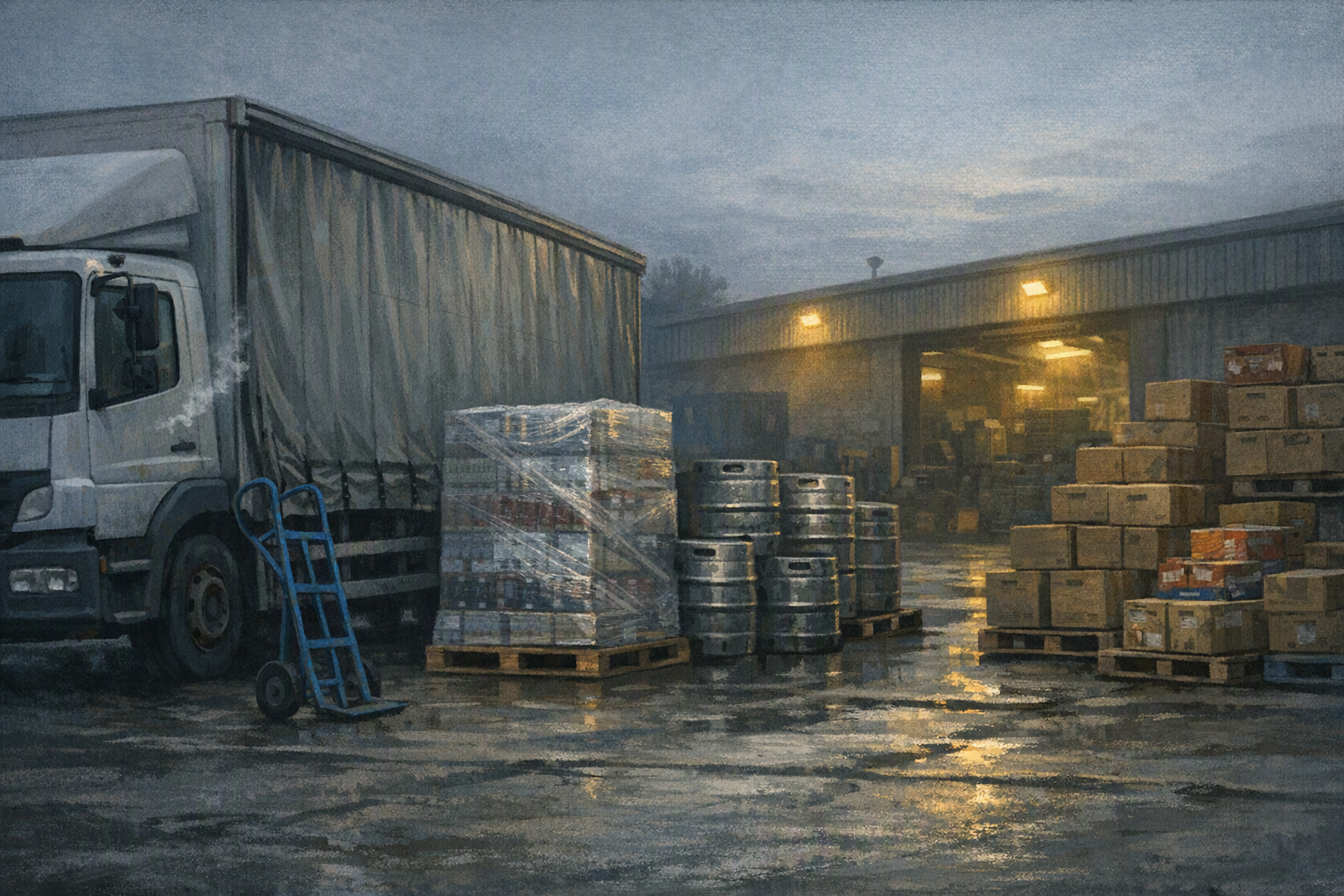
I had a spare summer in between university and starting work properly in the new year. I needed a job; I knew I didn’t want to work in a shop or an office. I was intrigued by an old-fashioned-looking advert for a “driver’s mate.”
I was interviewed by the matriarch, a grand lady called Pamela, well-spoken, pencil skirt, heels, pearls, lipstick, good hair. She had married into the family who gave their name to the business. She seemed ever so slightly dissatisfied to find that this was her life.
The pay was £3.70 an hour between 7 and 3 and time and a half between 3 and 5. I was issued just the one liveried polo shirt; I got a bang of the previous wearer’s Lynx as I pulled it on.
I arrived early on the Monday. There was already a short queue of three guys lined up to clock in. They each found a small piece of card with their name on it and inserted it into the slot of a machine for stamping. I copied them. It felt a bit dehumanising and undignified. According to a sign, stamping someone else’s card would be treated as gross misconduct. Much later, in my petulance, I found that it made no difference whether you stamped your card or not; you still got paid just the same. They must have chucked the cards in the bin.
The other men seemed much older to me. I was 21; they were probably in their forties. I can still remember most of them.
Tony was one of the forklift drivers. His teeth were the right size, but his face was too small for them. Slender, just over 5ft tall. Leathery, olive skin. A salt and pepper handlebar moustache. Furtive, busy eyes. Oil-stained blue jeans. The configuration of his teeth and face caused a whistling when he spoke; it was not an unpleasant sound, though you could not often say the same for his conversation. I realised he was close to the bottom of the social hierarchy.
Reggie was the longest-standing driver. Probably in his fifties. Blonde, thinning hair but still enough of it to style with a comb. Red face, high blood pressure. Mouth set into a sneer. Angry eyes, belligerent. He had utter contempt for the firm and especially for the other drivers. He reminded me of a fox.
Malcolm – he drove the other forklift but only when needed. The rest of the time, he did short drops in one of the vans. He had a baby face, short, greying curly hair. I could never work out if he was a young-looking old person or an old-looking young person. He lived with his Mum. His nickname was Pigeon because he once shat himself.
The warehouse used to be in the neighbouring town. After they moved it, the owners let the drivers use the vans to travel over. The pecking order was such that Reggie drove. Another wagon driver would be up front, Malcolm and a few others used to ride in the dark, stinking back.
Flash – he was a nice guy. He drove the “N” reg Mercedes lorry, the largest on the fleet. I was to work with him at first. A family man, he’d started out as a driver’s mate like me and worked his way up. He communicated mainly through impressions of other people or phrases from TV shows. Every day, as he drove through the high street, he would look for a fat person and then declare it to be “A day of fat people” in absolute genuine amazement.
7am – stamp card.
7am – 7:30 load the wagons. A mad half hour, both forklifts nipping in and out of the warehouse non-stop. Wagons queuing up waiting their turn. Drivers smoking fags, mates fastening curtains, checking paperwork, lifting cardboard boxes of crisps and pork scratchings.
7:30 – head out for the day. You could be going anywhere within the county or the two either side and even into London. The drivers knew the routes. Conversation was sparse.
On arrival, the driver would try and park as close as possible. They would go in and find the licensee. I would open the sides or the back and start loading up a sack barrow.
A load could be anything from ten aluminium barrels of beer to a slab of coke cans and some crisps. In exchange for cash, the stock would be rotated in the cellar, keeping the fresh to the back.
Most landlords would offer us a pint, both of us.
We ate lunch in between drops.
2 p.m. onwards – arrive back at the warehouse. The next day’s orders were waiting for us on clipboards.
The driver found their favourite spot of floor and stood still, calling out the orders in batches of what they considered the mate should be able to grab in one go. It was a memory game, not only of what had been called out but also, where it was stored.
We used blue sack barrows, like a large capital L. They had pneumatic tyres and a hook halfway up the back that you could drop over the lip of an 11-gallon barrel. If you were good, you could get two 11-gallon barrels side by side on the bottom, and another one on top.
They sold wine as well. There was some sort of unspoken collective trauma about that because now, only an actual manager was permitted to select wine and hand it to the driver.
3 p.m. – that was it. Each driver had created an island of pallets, one for each destination. Produce all cling-filmed into place. Clipboard laid on top, ready to go.
For reasons unclear, we all had to hang around for another two hours, for which, as I said earlier, we got overtime.
Almost everyone sat in the bait room drinking cups of tea, eating gone-off snacks, chatting rubbish. It wasn’t really my kind of thing. After a while, I slipped away and found myself a bit of a den in amongst the produce where I could sit and read my book.
I got paid in cash for the first two weeks. Something to do with not wanting to go to the trouble of setting up a bank transfer until I’d sunk or swum. One of the office girls used to fetch it down for me every Friday in a little envelope. A small handful of notes and a few coins. Tony always managed to be there when the girls came downstairs. He snatched the envelope from me, pressing it to his nose and inhaling as he asked her, “Has that been in your pocket?”
I gather he’d once been caught sniffing their stuff upstairs; he wasn’t allowed in the office anymore. He told me it was because he’d wiped his knob on the lady owner’s telephone in relation to some dispute or another. He talked a lot of nonsense. He was fond of reciting “Mary had a little lamb” limericks; they were funny the first time.
It should have been quite a jolly, happy place really, but it wasn’t. The owners were the second or third generation; there was no evidence of any passion for the business. I got the feeling they were trapped. There was a permanent cloud of decay and gloom; it was clearly not going to last long into the new century.
After a few weeks, I started to notice extra items being loaded. A pallet of cans of coke, a couple of barrels here and there. I didn’t say anything. I realised some of the drivers were making a bit of extra cash. It was a shame, but I guess they felt it was their way of correcting their petty grievances. The owners must have known about it.
I knew it was time to move on when 9/11 happened. There was no internet on mobile phones then, so it was a case of turning on a radio and listening. It had started to break as we headed back into the yard that afternoon. I was horrified; nothing like this had ever happened in the world of my 21-year experience. Nobody else seemed affected or even particularly interested. They carried on talking about tits and moaning about the firm as I sat in the cab of a parked lorry listening to the world changing.
I gave my notice at the end of that week.



Leave a Reply