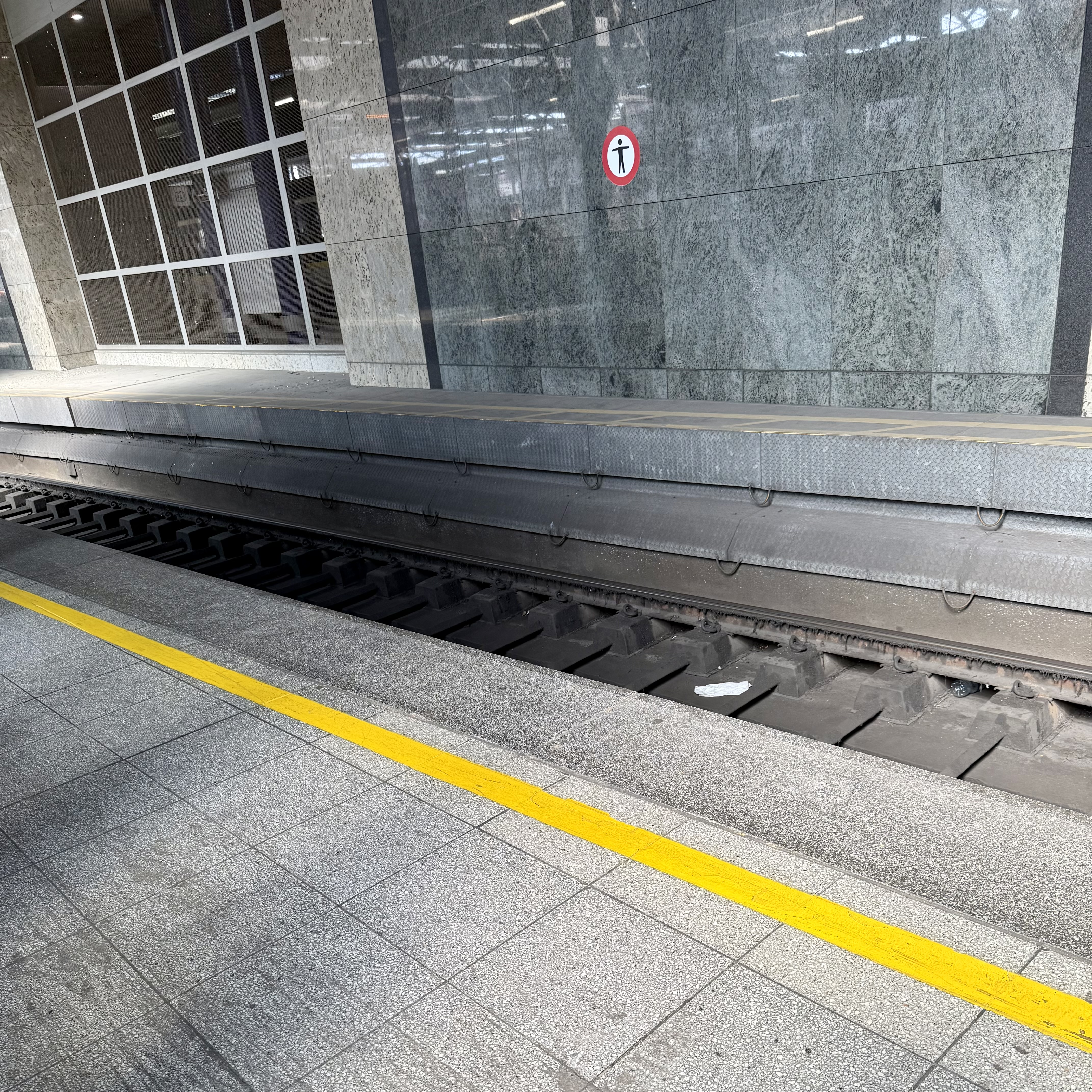
I’m on the last leg of a 900-mile railway journey. I’ll soon forget most of it, but not the man I sat next to under the Channel Tunnel. He was in his seventies, twinkling with fun. We chatted for two hours. He had been a professional musician all his life. Somewhere near the Kent coast, he told me he’d had a hard time finding his way through the station to where he was sitting, as he could not see very much. He explained he’d lost most of his vision a few years back. He wasn’t ready for a white stick; he didn’t want to be perceived in that way. He had asked a lady which platform the London train was from, and she’d pointed to a sign that he could not see, he’d sensed a bit of unkindness in her.
We talked about his music. I had a look on YouTube; he was surprised to know that his songs were on there. I told him if he uploaded them himself, he might be able to get some income from them.
He was proud of the cousin who was going to meet him. With difficulty, he found a photo of him stood in front of his house. I had an hour between trains, so I asked him if he’d like to follow me through the station when we arrived. He said “no thanks, I’ll be fine.” He was a proud man.
We waited for the carriage to empty. I made to carry his bag, but he wanted to do it. I walked ahead; he paused at the door. I told him how many steps there were and that there was a big gap to the platform. He passed me his bag, and I held my arm out to him as he stepped down.
The platform was teeming with people, all going in the same direction. I didn’t really know what to expect myself, as it had been ten years since I used this station. I offered my arm, but he said “you walk in front, I’ll follow your feet.” Despite that, I felt a hand on my shoulder a few times.
On the escalator, I told him it was the kind that has steps, not a slope. At the bottom, I told him when it was time to start walking. He told me he had nothing to declare customs-wise.
As we reached the arrivals area, I recognised his cousin from the photo. A nice-looking man a little younger than me, he beamed at us, recognising what was afoot. We shook hands, all of us, and I left them to it.
The wagtails chose our logshed. It’s right outside our kitchen door and we’re in and out non-stop. They must have priced that in and decided it was worth it. Perhaps they were more confident than their peers, or at least more able to balance the risk versus reward.
There was a cold snap in the middle of May. The heating was off for the summer, so I went to get some wood for the stove. I saw the nest, set in the air gap between two stacks of logs, full of tiny eggs. We decided we could manage without the logs after all.
As I say, we are in and out all the time, so I popped my head into the shed every day or so to see how they were doing. I missed them hatching, but soon enough there were five balls of black fluff with enormous yellow beaks and beady eyes looking back at me.
The mum and dad visited their babies about once a minute on average. I could see them through the window. They seemed to work as a team: one sat on the ridge of next door’s house keeping watch, the other flew into the nest with a beakful of long-legged insects. They were cautious, constantly scanning for danger. I guess there’s a lot of that: cats, foxes, bigger birds, humans. I felt like we were the least of their worries. I hope so.
One of them took a liking to the roof bars of my car, so I parked it alongside the shed for them. That went down very well. It had a white stalactite of approval running down the window within a day.
The logshed is built with two compartments separated by wide-gapped slats. On around day 6 of their lives, I popped my GoPro through from the other side and left it running.
The mum and dad were back feeding within 10 minutes. When I reviewed the footage, I could tell when they were about to arrive because the audiogram showed a spike in volume. The chicks could hear or sense the imminent arrival of a parent and ramped up their noise. They also seemed to be electrified at that point, their beaks thrust into the air, gaping open, demanding. The adults fed one or two chicks on each visit. They seemed to remember whose turn it was.
I noticed an adult flying away with what looked like a white egg in its beak and thought nothing of it. As I watched more footage, it happened again and I saw that I was wrong. One of the babies was fed, then turned around 180 degrees and presented its bottom to the adult before excreting a white sack straight into the waiting beak of the grown-up. The adult took it and flew off. I had to watch and rewatch that, and then do some research, but evidently faecal sacks are a thing. It makes total sense. The nest would soon get infested with parasites and attract predators if the waste were allowed to accumulate. Apparently, the parents also regularly eat it themselves.
On the 16th day, I noticed them as I came back from walking my dogs and took a quick photo on my phone. They looked different, expectant in some way. Later on, my neighbour asked if they had fledged, as he had seen several baby wagtails in his garden. He took these photos. When I checked, they had all gone. I was surprised how much I missed them, I kept checking the empty nest when I walked past.
I thought that was our bird drama for the year. Then the blackbirds moved into the polytunnel.
There were five eggs this time, much bigger than the wagtails’.
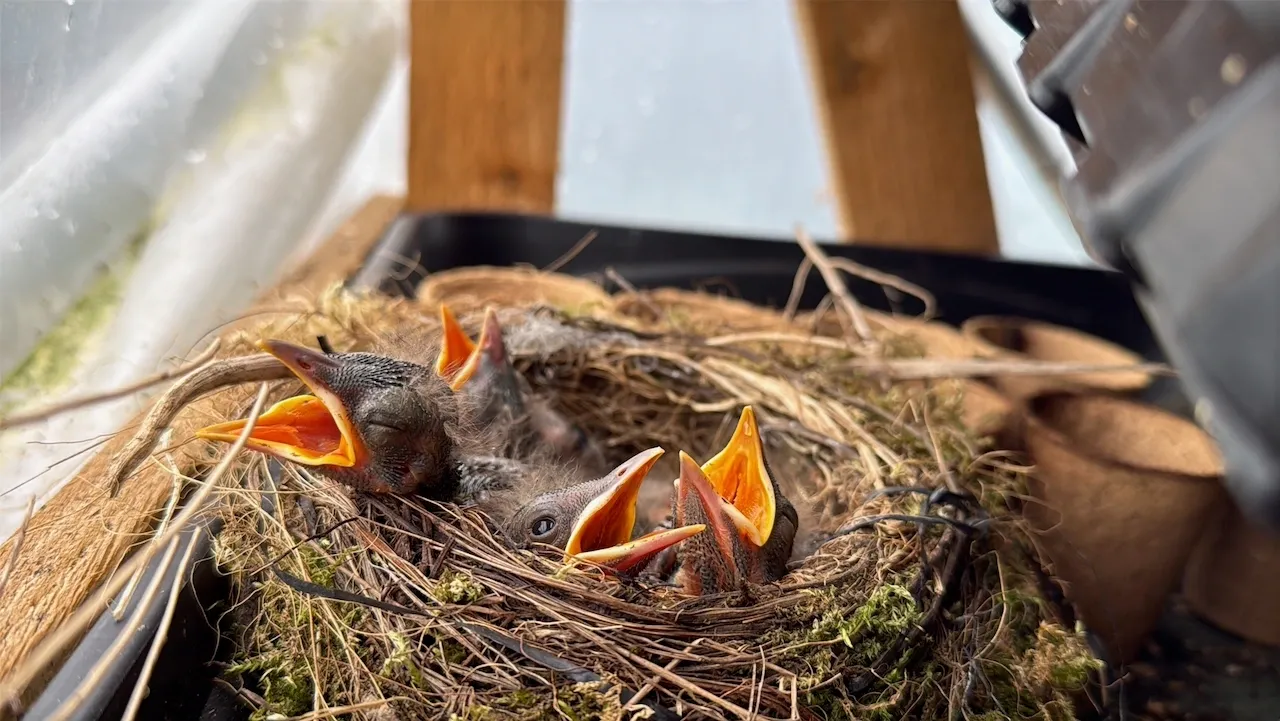
I grabbed a quick film of them whilst the mum and dad were away, you can see there were 3 eggs still to hatch. I left the GoPro pointing down at them from the planting shelf above and captured one of the eggs hatching. The babies looked like little aliens or dinosaurs. Huge bulging eyes that stayed shut. Wrinkly, see through skin. No wings yet, just stumps. They were unable even to raise their heads
I caught another noteworthy bowel movement, again it was taken away immediately by a parent. It was pure egg yolk, which actually makes sense considering where the baby bird had just been.
You can see their diet is also very different to the wagtails. The mum and dad are feeding them chunks of worm flesh in this clip. They are more aggressive, you can see the adult pecking the baby to prompt it to open its beak before ramming the food in.
After 6 days, they were unrecognisable – clearly now young birds with long yellow beaks, feathers and wings. Eyes open now, looking for the next meal delivery.
I noticed one of the babies wasn’t raising it’s head up for feeding. It was smaller than the others. It disappeared overnight. By the end of the 7th day, I could only see 3 babies.
By the evening of the 8th day, only one remained. There were no feathers or signs of anything happening. The parents were still feeding the baby. We set up a trail cam to monitor overnight and caught this rather overweight ginger intruder. We think he must have been responsible.
We kept the polytunnel shut overnight after that, the adult birds could still slip in and out under the door.
As far as I know, the little one made it. I had to go away for the weekend but my neighbour kept an eye on him. He had flown onto the tomato plants overnight and was gone within an hour. We haven’t seen him since.
I won’t forget these two families. They were tiny, frantic, filthy, vulnerable and completely committed to the job of being alive. With so many dangers, predators and points of failure, I found myself deeply respecting them. Without doubt, they put 100% effort into their lives. I’m not sure I can always say the same.
Dog walkers are always making grim discoveries. I was 18 when it happened to me.
I was with my terrier. I saw a small car in the distance. It was out of place, far from the nearest road.
I wandered over, curious. The windows were all misted up, the engine was ticking over. I could hear loud music playing. I circled around it, not getting too close in case it was a couple.
There was a garden hosepipe coming out of the exhaust. Someone had tried to seal it in place with red insulating tape. I took a step closer. There was a man in the driver’s seat, his forehead almost touching the steering wheel.
This was 1998. I had no mobile phone. I shouted “Help” and paused, holding my breath waiting for a reaction. There was none, nothing from the man in the car and not a sound from anyone else. I could not see another soul in any direction. I felt I had to do something. I pulled the hosepipe out of the exhaust. At least things could not get any worse now.
I tried the door handles. All three doors were locked. The passenger window was cracked open to let the hosepipe in.
I kicked the glass as hard as I could, connecting with the flat of my foot. Nothing happened.
I found a hefty stick. The window smashed to pieces the first time I hit it.
I reached in and unlocked the door. The air was hot. It caught my throat even though I tried not to breathe. I leaned across the man’s shoulders and unlocked the driver’s door. I walked around to his side and opened the door. He was cherry red, unconscious, floppy. He had been sick on his lap. He had no seatbelt on. I took his arm and pulled. I’d never been around an unconscious person before. The way he fell to the ground was disturbing – he behaved like an object rather than a person. He landed on his side. I rolled him onto his back.
I slapped his face gently. His eyes were fixed, unfocused. I gave him a few chest compressions whilst I thought about what to do. I’d never done that to a real person before. It felt horrible, violent. There was froth coming from his mouth, so I decided against any mouth-to-mouth.
The CPR wasn’t doing anything, and there was nobody else around. It felt wrong to leave him by himself. I knew if I went to get help, it would take too long by the time I took them to him. I decided to try and move us both closer to the main road.
I tilted the driver’s seat forwards and dragged his upper body back towards the car. Somehow, I bundled his torso into the space behind it. He was a bit bigger than me, so I couldn’t get his legs in. He ended up on his front with his face resting on some of the broken glass. As I put the seat back down, I felt resistance; I think that was his arm. The windscreen was still steamed up on the inside, and the wipers didn’t help. I didn’t want my dog cutting himself, so I kept him outside on the end of his extendible lead. The gearbox and pedals were different to what I was used to. I found first gear and let the clutch out, slowly, with lots of revs. I had to go about a third of a mile around a ditch to get towards the road. I was hooting the horn because I couldn’t really see where I was going. I noticed a flattened cardboard box on the passenger seat. It had once contained a car foot pump. I would read it later; it said “to whoever finds me.” The handwriting started off very neat but by the end it had faded to a scrawl.
I stopped just near where my own car was parked. A couple were just about to start their afternoon walk; they looked frightened. They soon realised I needed help and ran over. She was a nurse or a midwife; she was much better at the CPR than I had been. A small crowd started to form; someone must have had a phone, and a 999 call was made.
Within a few minutes, the ambulance arrived; they took over. The defibrillator didn’t make any difference, and after a while, they stopped; they put a red blanket over the man.
The police came. There was a sergeant in his 30s, plain clothes. He asked me to show a young PC the place where I’d found the man. The PC told me not to blame myself. Until he said that, the thought hadn’t even crossed my mind.
I gave my details, and they said I could go.
A few weeks later, a retired policeman from the Coroner’s office came to see me at my mum and dad’s house. He took a statement.
I had to go to the inquest. I went on my own. I found myself sat next to the man’s wife as we waited for it to start. As a sixth former, I didn’t really know what to say to a lady whose husband had died like that.
I didn’t read my statement as such. An official had a copy of it in his hand; he read it out as a series of questions that I could agree with. That was it; they said I could go; I never heard any more.
I’m 46 now. Every day, I still think about the car in the distance and the man inside it. It didn’t do me any harm, but my life was different after. I’ve carried on doing my best to do the right thing and not to look the other way. I’ve had some good adventures doing that.
If you feel you are affected by the issues raised in this post then please speak to the Samaritans, click here to visit their website or call 116 123.