We try to keep two weeks free every summer and see what the weather allows.
Some years the forecast is perfect and we do something ambitious like circumnavigating Raasay and Rona. Other years the Atlantic does what the Atlantic usually does and we cancel the leave and go back to work.
This trip sat somewhere in between.
Scotland was clearly off the table, but there was a narrow 24-hour window of settled weather locally and, crucially, the tides lined up. That was enough to tempt us out. The plan became a quick crossing to Piel Island.
The tides around the Duddon Estuary can be awkward, so I dug out a guidebook, Northern England and IOM: Fifty Great Sea Kayak Voyages by Jim Krawiecki. It recommends launching from the north end of Walney Island.

Unfortunately, that would have required driving to Barrow-in-Furness.
Neither of us could quite summon the enthusiasm for a one-hour 50-minute drive when the sea was already visible from my house, so we decided instead to paddle across from Silecroft in West Cumbria.
High tide was 06:51.
Low tide at the mouth of the Duddon would arrive at 13:30.
We needed to be well clear of the estuary before then.
We left Nick’s car in the parish council car park at Silecroft at about 08:30, packing just enough food and beer for 24 hours.

The car park signage suggested the parish council preferred people not to stay overnight. We had intended to let them know what we were doing, but the contact number I had for them no longer worked.
We decided to risk it.
The sea was grey and slightly lumpy. It felt much cooler than July ought to, but it was good paddling. Through breaks in the cloud, the southern fells appeared almost unreal – ridges fading in and out of mist.

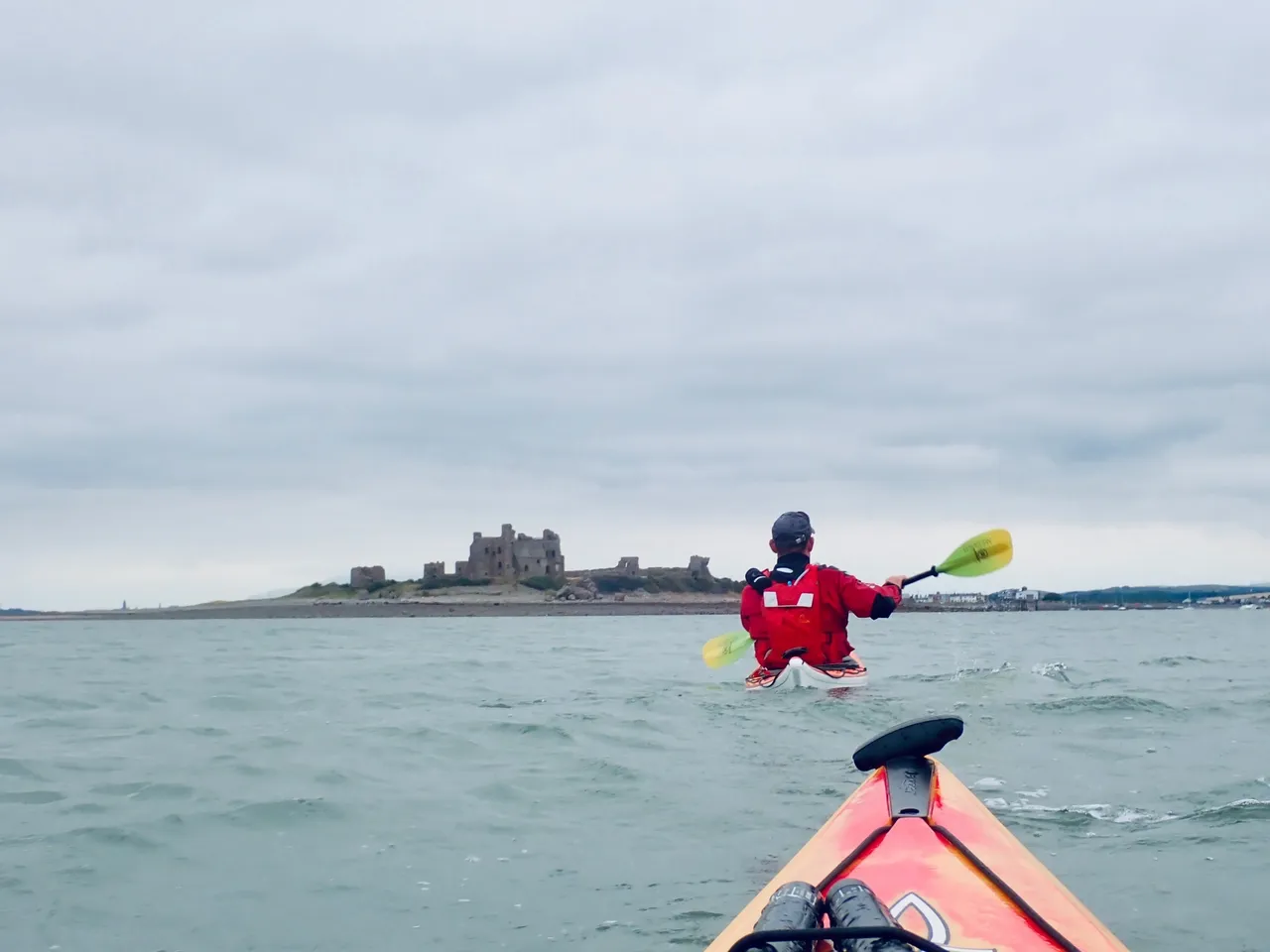
Within half an hour, we were clear of Haverigg and committed to the crossing. A group of seals seemed to find us quite interesting from a discreet distance. They were bigger than the ones we are used to seeing in Scotland.
I’m not sure why, but you can tell when you’re kayaking over shallow water; the boat just feels different, slower, more resistive to paddling. We were half a mile or more from land, but ran out of water due to a 30-40m wide sand bar with no visible ends.
Mindful of the falling tide, we decided to get out and drag ourselves over it on foot rather than try to go around it and risk being beached.

Once back afloat, we could very clearly now see the top of Walney Island. Our plan was to head down the Western/seaward side of it.
We stopped for lunch at Walney Island Beach, near West Shore Road. It was nearly low tide, so we pulled the kayaks clear and walked 200m or so to a slipway where we heated up some boil-in-the-bag. I went for an all-day breakfast. I have such a love-hate relationship with these things; I definitely thoroughly hate them by the end of a trip. The first one is always surprisingly less disgusting than I remembered, but by the second, I realise I was right all along. This one wasn’t too bad; I appreciated a hot meal under the circumstances.

It didn’t take us too long to reach the bottom of the island; we turned left and were treated to our first glimpse of Piel Castle. It looked incongruous, a ghost from the past. The castle still dominated the island, even as a ruin.
We landed by the ferry slip. Steps led up to the Ship Inn. The landlord of the Inn is also, officially, the King of Piel. So, we found the King, a friendly man in his 30s not long crowned and busy behind the bar. A loud, well-oiled customer was trying to hold court with some story or another, clutching the counter with one hand. There were half a dozen or so other customers, all desperately avoiding any eye contact with him. Everyone looked around as we walked in; dressed as we were in rubber trousers, cagoules, and buoyancy aids, we were definitely a welcome diversion.
I asked the King if we could camp on his island.
“Anywhere you like” was his easy reply. £5 per night, an exceptional bargain.
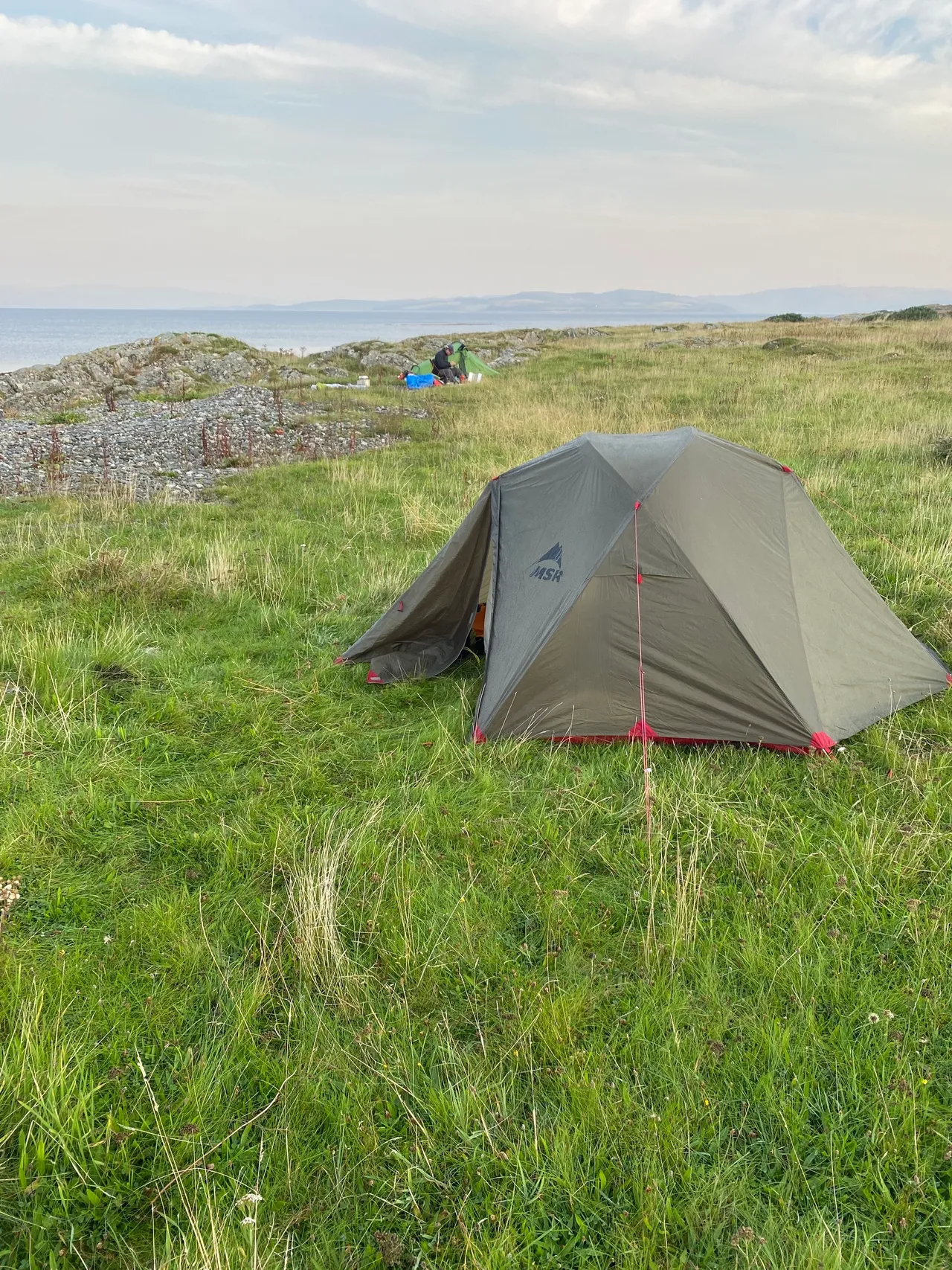
Everywhere around the pub was already fairly chock-a-block with tents, so we got back into the kayaks and paddled 400m or so around the coast, settling on a flat, grassy strip not far from some of the houses.

Once the tents were up, we found the castle – note the opening hours “Any reasonable time”. The King joined us with his dogs briefly; without saying it, he clearly needed a little bit of time away from the bar.


We dined on dehydrated Chicken Tikka Masala and then adjourned to the bar.
We found a side room full of nautical curiosities and photos and made ourselves at home. Several pints later, long after it had got dark, a private number called Nick’s telephone. It was Cumbria Police – the parish council car park committee at Silecroft had seen us paddle away over the horizon and were worried as our car was still there. This had caused a terribly embarrassing sequence of events – Bedfordshire police going to Nick’s home address, getting contact details from his wife, passing them to Cumbria police. We made our apologies to the police and thanked them for their concern.

We had a very early start the next day; high tide was 08:00, we needed to be well clear of Duddon Estuary on the way back. I needn’t have set an alarm because at 5 a.m. a dredger passed seemingly a few feet from our tents, making a noise like a surprised cow.
We had filled our flasks with boiling water the night before to save time, so breakfast was a perfunctory porridge and tea before we got back on the water.

We reached BAE Systems (where they make nuclear submarines). A massive contrast to be amongst such a futuristic estate only a short paddle from a 14th-century castle with its own reigning King.
Under the road bridge and by the time we hit the estuary, the wind was picking up considerably. The waves were coming in at between 45 and 90 degrees, and they were breaking into surf as they got closer to the land. Surf is a problem for kayakers; there’s not a lot you can do if a wave breaks over the side of your boat. It would mean a certain capsize, potentially loss of kit, injury, and a cold dunking. We deliberately took a path further out to sea, balancing the risk of being unable to swim for shore vs hopefully not needing to.
It was probably just slightly the wrong side of enjoyable at times. Loaded boats tend to be better to handle in these conditions, and thankfully, we had a considerable cargo of un-drunk beer thanks to the pub being open.
We’re pretty good at keeping each other’s spirits up and soldiering on. We only stopped once, for a quick brew from a flask because the conditions were set to deteriorate further.
I was starting to think about landing and carrying the boats to the nearest road, but it didn’t quite come to that as Silecroft grew from a dot on the horizon to the very welcome sight of Nick’s parked car. With an angry-looking lady standing next to it, hands on hips. It was going to be telling-off time.
“I know exactly where you’ve been.”
We must have looked fairly sheepish; her expression softened a little. All the same, she had definitely been looking forward to this moment and was not going to be easily deprived of it. We had a chat for about five minutes, explaining we were just local guys out for some harmless adventures. I made a genuine apology, and with that, and a suitable contribution to the car park honesty box, we were on our way home for fish and chips.
The kit used on this trip
If you are curious about my kit, here are some links to it so you can learn more and check the prices on Amazon UK. None of this kit is sponsored. It’s simply what I use.
Trip planning was assisted by the excellent guidebook: Northern England and IOM – Fifty Great Sea Kayak Voyages by Jim Krawiecki.
VHF Radio – ICOM IC-M25 Euro EVO Marine VHF Radio Small, waterproof, rechargeable. I have used mine for several years, it can easily go a week without losing charge. There’s a reason why most sea kayakers prefer this one.
Satellite Beacon (PLB) – rescueME PLB1 personal locator beacon. Carried on the fells and permanently in my buoyancy aid at sea, more for peace of mind than anything else. This is the subscription-free kind.
LED Strobe Beacon – Odeo LED distress flare Lives on my shoulder strap; bright enough to get noticed without looking tactical.
iPhone 16 Pro – Used for navigation, GPS trail logging and photography. Waterproof, tough, simply brilliant.
Aquapac Waterproof Large Phone Case I’ve got 3 cheap broken phone cases and this one which I bought in 2020 and still use all the time.
GoPro Hero 12 – action camera.
GoPro clip mount I like to carry my GoPro clipped onto my buoyancy aid. This clip is tried and tested, you can also use it on a rucksack or similar.
Olympus tough camera I’m still on the TG-5 which is no longer made, this link is for the new model. It’s waterproof and takes great stills, includes GPS tagging. I keep mine in the pocket of my buoyancy aid.
Uncle Paul boat dry bags I have about 12 different Uncle Paul dry bags in a variety of sizes. I’ve been using them since 2021, I think they are perfect for kayaking. I also use them in my rucksack for walking. You can get all your clothes, food and kit into them and never worry about water damage.
MSR Dragonfly petrol powered stove I have been using mine since 2020, it’s bombproof as long as you treat it with respect. I really must do a proper review of it soon.
MSR Alpine 2-pot mess set I’ve used this since around 2022, very happy with it. I keep my tea bags, mug, cutlery inside it to save space.
Leatherman Wave+ I have done a detailed written review of my Wave+ here
MSR Elixir 2 person lightweight tent My tent also gets its own write up here
As an Amazon Associate, I earn from qualifying purchases.
I buy all my own gear and write independent reviews. If you found this helpful, why not buy me a coffee



Leave a Reply