Author: Robert Twentyman

  • Helvellyn

    Helvellyn

    The route from Patterdale up Striding Edge and down Swirral Edge is one of the Lake District’s great circular walks, although parts of it feel less like walking and more like negotiating a geological argument.

    My walking buddies were an old school friend and some of his pals. Like many Lake District days, we met up in a pay and display car park. We chose the one opposite the Patterdale Hotel, a very reasonable £5 for the day (cash only). 

    Apple fitness snail trail of route

    We set off down the road, picked up part of the Coast to Coast path and then worked our way cross-country towards Bleaberry Crag.

    The first couple of miles were deceptively steady going. One of our group had a catastrophic walking boot failure within the first hour. Both of his heels completely delaminated; thankfully, I had some gaffa tape and a bit of paracord in my first aid kit. I was able to patch him up enough for him to return to his car. The rest of us continued. 

    Miles 3, 4 and 5 were an intensive cardio and quad workout. My average heart rate for mile 4 was 166 bpm as we hauled our way up towards the start of Striding Edge. 

    Evidence of my lack of fitness for all to see! Mile 4 was the killer.

    The conditions were perfect, no low clouds, not too hot, nice and dry and no wind. It wasn’t overly busy although there was by now a steady flow of other walkers. We caught our breath before Striding Edge proper; I took on some chocolate and coffee just in case. 

    You have no choice but to take Striding Edge seriously; there are severe drops on either side – approximately 300m to the left and 150m to the right. Even on a good day, a moment of inattention could be fatal. You could also observe that this is one of the most mindful ways to spend a Saturday morning. When you’re busy thinking about exactly where your hands and feet need to be; it’s impossible to worry about anything else!

    This route is superb because you can see and anticipate the full semi-circle of Striding Edge, the summit, and Swirral Edge at all times. Rather like the rides at Alton Towers where you observe the most exciting bits as you queue up. Red Tarn is a beautiful, inky, black feature below you and to the right as you approach the summit. 

    Towards the end of Striding Edge, there is a 4-5m descent where you need to turn around and downclimb. It felt safe to me as there were plenty of good, solid hand and footholds, but it could be quite daunting. Just after that is a slightly longer scramble up leading to the Charles Gough memorial.

    The Charles Gough memorial. Click on it to learn more about it and a transcript of what it says.

    I’d forgotten all about him, but the memorial sent me down a Wikipedia rabbit hole. Gough was an artist born in 1784. Originally from Manchester, he set off to do the same walk as us on 17 April 1805. He fell from roughly where his memorial stands and died of a suspected head injury. His body was discovered by a shepherd on 27 July. His dog, Foxie, had stayed with him for all of that time, surviving by drinking from the tarn and scavenging. 

    The striking flat plateau at the top of Helvellyn

    We took a few photos and then headed down by Swirral Edge, an enjoyable route but not as difficult as Striding Edge. We chose a different way, crossing the top of Red Tarn and down into Glenridding. By the time we reached the Traveller’s Rest, we’d covered just over nine miles, climbed one of England’s best-known ridges and frightened my cardiovascular system sufficiently for one day. We took our time nursing our pints with our boots off before making the last mile through the village and back to the car at Patterdale. 

    Apple workout data

    * Distance: 10.04 miles

    * Elevation gain: 3,366 ft

    * Moving time: 5 hrs 1 min

    * Total elapsed: just under 6 hours

    * Route: Patterdale → Striding Edge → Helvellyn → Swirral Edge → Patterdale

    * Highest recorded HR: 177 bpm

    * Recovery strategy: one pint in Glenridding

    Resources

    Lake District National Park Fell Top Assessors home page 

    Lake District Weather Line winter conditions report

    Patterdale Mountain Rescue Team homepage

    If you are curious about the kit I used, here are some links so you can learn more and check prices on Amazon. None of this gear is sponsored. It’s simply what I use and trust.

    Ordnance Survey Map OL5 this is the best map for a climb of Helvellyn

    Compass – this one is decent quality, it has a few more advanced features. Could be very handy in low visibility. 

    Satellite Beacon (PLB) – rescueME PLB1 – A subscription-free personal locator beacon. I carry it on the fells and permanently in my buoyancy aid at sea, more for peace of mind than anything else.

    Whistle – Lifesystems Safety And Emergency Whistle always carry one when on the water or in the fells

    Watch – Apple Watch Ultra 3 I use the Ultra 3 for route tracking, elevation and heart rate monitoring. My review is here:

    Head Torch – LED Lenser H7R Core. I didn’t need it this time, but if there was any realistic chance of darkness I would absolutely pack it. My review is here:

    Lifesystems Mountain First Aid Kit I have carried mine since 2020 for hiking and kayaking, it’s a great all round kit. Had to replace the gaffa tape after this trip!

    Aquapac Waterproof Large Phone Case you get what you pay for, I’m very pleased with mine. Aquapac also make great map cases.

    GoPro Hero 12 – The action camera used for the POV footage. There is a newer model on sale but the 12 is still very good. 

    GoPro Clip Mount – I usually clip the GoPro onto my buoyancy aid when kayaking, but it also works well attached to a rucksack strap.

    Paracord – I’ve just ordered this to replace the section used during the emergency boot repair on this walk. Looks ideal for general emergency use.

    Gaffa Tape I now wrap a couple of metres around a Sharpie pen and keep it in my first aid kit. 

    UK Map App (the link is to the Apple App Store). This app has not got great reviews, it deserves better- I’ve had it for years. You can download maps and use it offline, it rotates based on where you are facing. I use it all the time. 

    Leatherman Wave+ One of the few bits of kit I carry almost everywhere. I’ve written a detailed review here:

    Mobile Phone Charger / Battery Bank – Anker 20K – I carry the Anker 20K power bank with built-in USB-C cable. Full review here:

    As an Amazon Associate, I earn from qualifying purchases.

    I buy all my own gear and write independent reviews. If you found this helpful, buy me a coffee.

  • The car in the distance

    The car in the distance

    Dog walkers are always making grim discoveries. I was 18 when it happened to me.  

    I was with my terrier. I saw a small car in the distance. It was out of place, far from the nearest road. 

    I wandered over, curious. The windows were all misted up, the engine was ticking over. I could hear loud music playing. I circled around it, not getting too close in case it was a couple.  

    There was a garden hosepipe coming out of the exhaust. Someone had tried to seal it in place with red insulating tape. I took a step closer. There was a man in the driver’s seat, his forehead almost touching the steering wheel.

    This was 1998. I had no mobile phone. I shouted “Help” and paused, holding my breath waiting for a reaction. There was none, nothing from the man in the car and not a sound from anyone else. I could not see another soul in any direction. I felt I had to do something. I pulled the hosepipe out of the exhaust. At least things could not get any worse now.  

    I tried the door handles. All three doors were locked. The passenger window was cracked open to let the hosepipe in.  

    I kicked the glass as hard as I could, connecting with the flat of my foot. Nothing happened.

    I found a hefty stick. The window smashed to pieces the first time I hit it.  

    I reached in and unlocked the door.  The air was hot. It caught my throat even though I tried not to breathe. I leaned across the man’s shoulders and unlocked the driver’s door.  I walked around to his side and opened the door. He was cherry red, unconscious, floppy. He had been sick on his lap. He had no seatbelt on. I took his arm and pulled. I’d never been around an unconscious person before. The way he fell to the ground was disturbing – he behaved like an object rather than a person. He landed on his side. I rolled him onto his back.  

    I slapped his face gently. His eyes were fixed, unfocused. I gave him a few chest compressions whilst I thought about what to do. I’d never done that to a real person before. It felt horrible, violent. There was froth coming from his mouth, so I decided against any mouth-to-mouth.  

    The CPR wasn’t doing anything, and there was nobody else around. It felt wrong to leave him by himself. I knew if I went to get help, it would take too long by the time I took them to him.  I decided to try and move us both closer to the main road.  

    I tilted the driver’s seat forwards and dragged his upper body back towards the car. Somehow, I bundled his torso into the space behind it. He was a bit bigger than me, so I couldn’t get his legs in. He ended up on his front with his face resting on some of the broken glass. As I put the seat back down, I felt resistance; I think that was his arm. The windscreen was still steamed up on the inside, and the wipers didn’t help.  I didn’t want my dog cutting himself, so I kept him outside on the end of his extendible lead. The gearbox and pedals were different to what I was used to. I found first gear and let the clutch out, slowly, with lots of revs. I had to go about a third of a mile around a ditch to get towards the road. I was hooting the horn because I couldn’t really see where I was going. I noticed a flattened cardboard box on the passenger seat. It had once contained a car foot pump. I would read it later; it said “to whoever finds me.” The handwriting started off very neat but by the end it had faded to a scrawl.  

    I stopped just near where my own car was parked. A couple were just about to start their afternoon walk; they looked frightened. They soon realised I needed help and ran over. She was a nurse or a midwife; she was much better at the CPR than I had been. A small crowd started to form; someone must have had a phone, and a 999 call was made.  

    Within a few minutes, the ambulance arrived; they took over. The defibrillator didn’t make any difference, and after a while, they stopped; they put a red blanket over the man. 

    The police came. There was a sergeant in his 30s, plain clothes. He asked me to show a young PC the place where I’d found the man. The PC told me not to blame myself. Until he said that, the thought hadn’t even crossed my mind.  

    I gave my details, and they said I could go. 

    A few weeks later, a retired policeman from the Coroner’s office came to see me at my mum and dad’s house. He took a statement. 

    I had to go to the inquest. I went on my own. I found myself sat next to the man’s wife as we waited for it to start. As a sixth former, I didn’t really know what to say to a lady whose husband had died like that.  

    I didn’t read my statement as such. An official had a copy of it in his hand; he read it out as a series of questions that I could agree with. That was it; they said I could go; I never heard any more.  

    I’m 46 now. Every day, I still think about the car in the distance and the man inside it. It didn’t do me any harm, but my life was different after. I’ve carried on doing my best to do the right thing and not to look the other way. I’ve had some good adventures doing that. 

    If you feel you are affected by the issues raised in this post then please speak to the Samaritans, click here to visit their website or call 116 123.

  • Anker Mobile Power Bank

    Anker Mobile Power Bank

    When you’ve spent good money on decent tech, you quickly realise how dependent you are on it. Phone, watch, laptop. All useful right up to the moment the battery dies.

    For trips away, especially anything off-grid, a reliable power bank stops being a nice-to-have and becomes essential.

    I chose this Anker 20,000mAh portable charger. I’ve had it since December 2025, used it on several trips, and more recently put it through a fairly obsessive round of testing at home.

    I’m very happy with it.

    TL;DR

    •  Kept my iPhone 16 Pro going for about 4 days
    •  Ran out during day 5
    •  Recharges very quickly when you get the chance
    •  Built-in percentage display is genuinely useful- way better than the 4 vague LEDs you often get 
    •  Integrated USB-C lead is a simple but excellent feature
    •  The last 10% does not do anything

    Main features

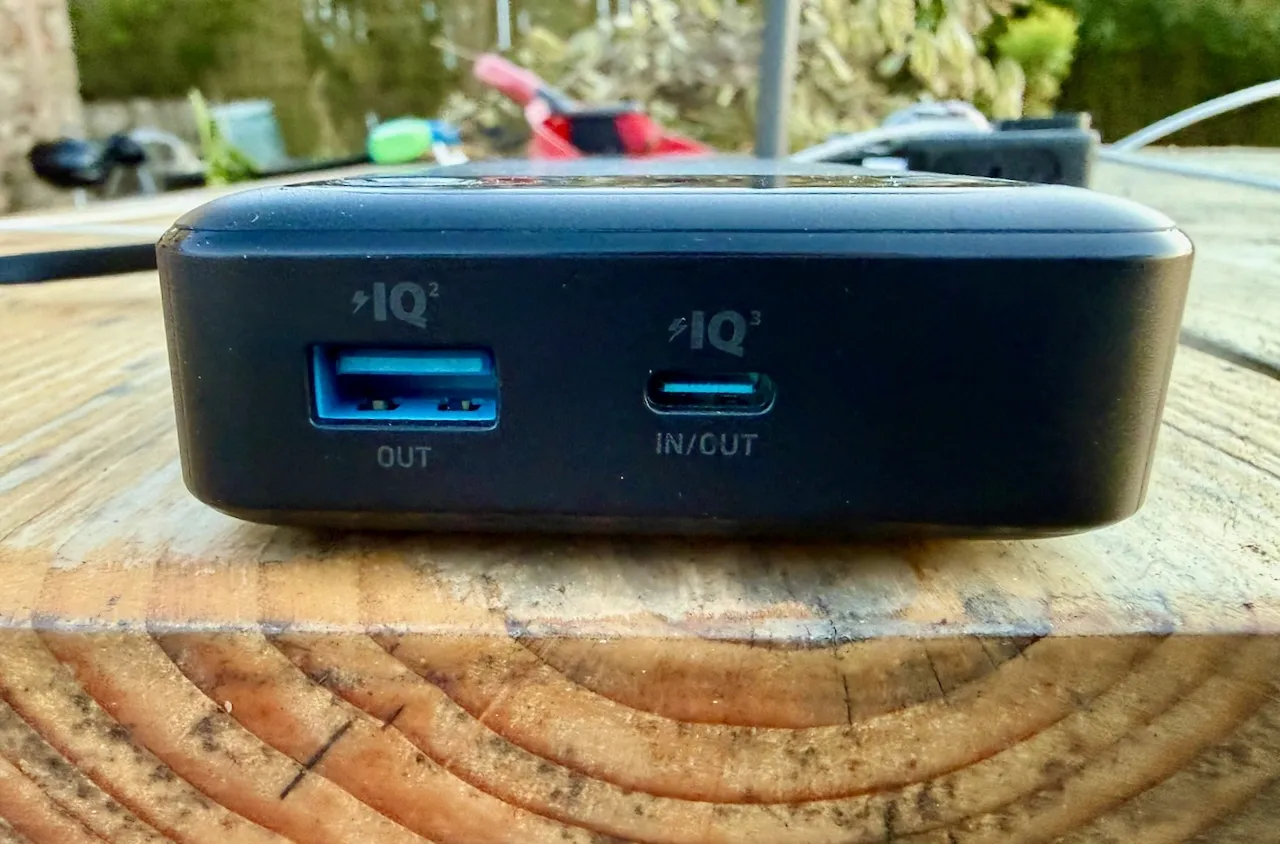
    •  Built-in USB-C lead that can both charge devices and recharge the power bank
    •  Fast charging up to 87W
    •  20,000mAh capacity, roughly comparable to a MacBook Air battery in energy terms
    •  Digital display showing exact remaining charge
    •  Can charge up to three devices at once
    •  Charges itself quickly, I saw around 64W in real use
    •  Size roughly similar to an iPhone Pro in a case
    •  Weight 421g. For context, my phone is 262g and a pint of water is about 840g

    What is mAh ?

    Power banks are usually rated in mAh, which stands for milliamp hours.

    In simple terms, it is a measure of how much electrical charge the battery can deliver over time.

    So a 20,000mAh battery could theoretically supply:

    * 20 amps for 1 hour

    * 1 amp for 20 hours

    That is useful, but not the best way to compare devices.

    A better unit is watt hours, which accounts for voltage as well:

    Wh = (mAh × Voltage) ÷ 1,000

    Most lithium batteries use cells at around 3.7 volts:

    20,000 × 3.7 ÷ 1,000 ≈ 74Wh

    That gives you a much clearer idea of the actual energy available.

    Real-world testing

    Click here for my detailed test report

    Over about two and a half weeks, I ran a series of simple but repeatable tests to see what this battery actually delivers.

    I tracked starting and ending percentages for both the phone and the power bank across multiple sessions, including:

    * Charging my iPhone in normal overnight use

    * Charging the same phone in flight mode

    * Charging an Apple Watch Ultra

    * Charging a MacBook Air M4

    * Charging an iPad Air

    What I found

    iPhone performance

    In normal use, the battery delivered around:

    2.7% of iPhone charge for every 1% of battery used

    In practice, that works out at:

    roughly 2.4 to 2.7 full charges

    With the phone in flight mode, the picture changes:

    around 3.7% of iPhone charge per 1% of battery

    That is an improvement of roughly:

    35 to 40 percent – well worth having on a camping trip.  

    What that means in real life

    A simple way to think about it is to compare how much charge you get with how much you use each day.

    From my testing:

    * Normal use gives about 240% total phone charge

    * Efficient use i.e. flight mode gives about 300%

    Worked example

    If you use around 60% of your phone battery per day, for example from 90% down to 30%:

    * 240 ÷ 60 = 4 days of use

    * 300 ÷ 60 = 5 days of use

    That matches what I saw in practice.

    Apple Watch

    The Apple Watch barely registers.

    Each 1% of the battery delivered around 14 to 15% of charge to the watch.

    In practical terms, you can charge it well over a dozen times and not worry about it.

    MacBook Air

    The MacBook is a different story.

    Each 1% of battery delivered less than 1% to the laptop.

    That is enough for a useful top-up, but not a full recharge.

    iPad Air

    The iPad sits somewhere in between.

    Each 1% of battery delivered around 1.8 to 1.9% to the iPad.

    That works out at roughly one and a half to two full charges.

    The last 10 percent

    One consistent finding was that the final 10% of the battery was not meaningfully usable.

    Across multiple tests, that last portion delivered little or no practical charge.  It is best treated as reserve rather than capacity.

    Flight mode insight

    The most interesting finding from all of this was the impact of flight mode.

    With the phone connected normally, part of the energy is constantly being used for background activity. Syncing, notifications, general housekeeping.

    Switching to flight mode removes most of that.

    The result is a noticeable increase in charging efficiency. Not theoretical, but measurable.

    It is a simple trick, but worth remembering if you are trying to stretch things over several days.

    Verdict

    This is a well thought out, practical piece of kit.

    It does exactly what you want from a power bank. It is reliable, fast to recharge, and gives you a clear idea of how much capacity you have left.

    In real-world use:

    * Expect around 2.5 to 3 phone charges

    * More if you are careful with how you use it

    * Enough capacity for a long weekend off-grid without worry

    The built-in cable and percentage display are small details, but they make a difference in practice.

    If you are heading away from reliable power for a few days, this is a sensible thing to take with you.

    Check price on Amazon

    As an Amazon associate, I earn a small commission from qualifying purchases but they do not cost you a penny extra.  

    I buy all my own gear and write independent reviews. If you found this helpful,buy me a coffee.

    Leave a Reply