Category: Adventures

  • Piel Island

    Piel Island

    We try to keep two weeks free every summer and see what the weather allows.

    Some years the forecast is perfect and we do something ambitious like circumnavigating Raasay and Rona. Other years the Atlantic does what the Atlantic usually does and we cancel the leave and go back to work.

    This trip sat somewhere in between.

    Scotland was clearly off the table, but there was a narrow 24-hour window of settled weather locally and, crucially, the tides lined up. That was enough to tempt us out. The plan became a quick crossing to Piel Island.

    The tides around the Duddon Estuary can be awkward, so I dug out a guidebook, Northern England and IOM: Fifty Great Sea Kayak Voyages  by Jim Krawiecki. It recommends launching from the north end of Walney Island.

    Walney Island route page in the Northern England sea-kayaking guidebook

    Unfortunately, that would have required driving to Barrow-in-Furness.

    Neither of us could quite summon the enthusiasm for a one-hour 50-minute drive when the sea was already visible from my house, so we decided instead to paddle across from Silecroft in West Cumbria.

    High tide was 06:51.

    Low tide at the mouth of the Duddon would arrive at 13:30.

    We needed to be well clear of the estuary before then.

    We left Nick’s car in the parish council car park at Silecroft at about 08:30, packing just enough food and beer for 24 hours.

    Two sea kayaks and paddling equipment laid out on Silecroft beach

    The car park signage suggested the parish council preferred people not to stay overnight. We had intended to let them know what we were doing, but the contact number I had for them no longer worked.

    We decided to risk it.

    The sea was grey and slightly lumpy. It felt much cooler than July ought to, but it was good paddling. Through breaks in the cloud, the southern fells appeared almost unreal – ridges fading in and out of mist.

    View from a sea kayak towards the southern Lake District fells beneath low cloud

    Within half an hour, we were clear of Haverigg and committed to the crossing. A group of seals seemed to find us quite interesting from a discreet distance. They were bigger than the ones we are used to seeing in Scotland. 

    I’m not sure why, but you can tell when you’re kayaking over shallow water; the boat just feels different, slower, more resistive to paddling. We were half a mile or more from land, but ran out of water due to a 30-40m wide sand bar with no visible ends. 

    Mindful of the falling tide, we decided to get out and drag ourselves over it on foot rather than try to go around it and risk being beached. 

    Two kayakers crossing shallow water over a sandbank on the falling tide

    Once back afloat, we could very clearly now see the top of Walney Island. Our plan was to head down the Western/seaward side of it. 

    We stopped for lunch at Walney Island Beach, near West Shore Road. It was nearly low tide, so we pulled the kayaks clear and walked 200m or so to a slipway where we heated up some boil-in-the-bag. I went for an all-day breakfast. I have such a love-hate relationship with these things; I definitely thoroughly hate them by the end of a trip. The first one is always surprisingly less disgusting than I remembered, but by the second, I realise I was right all along. This one wasn’t too bad; I appreciated a hot meal under the circumstances. 

    Kayaker (me) in paddling gear beside cooking equipment during a lunch stop on the shore

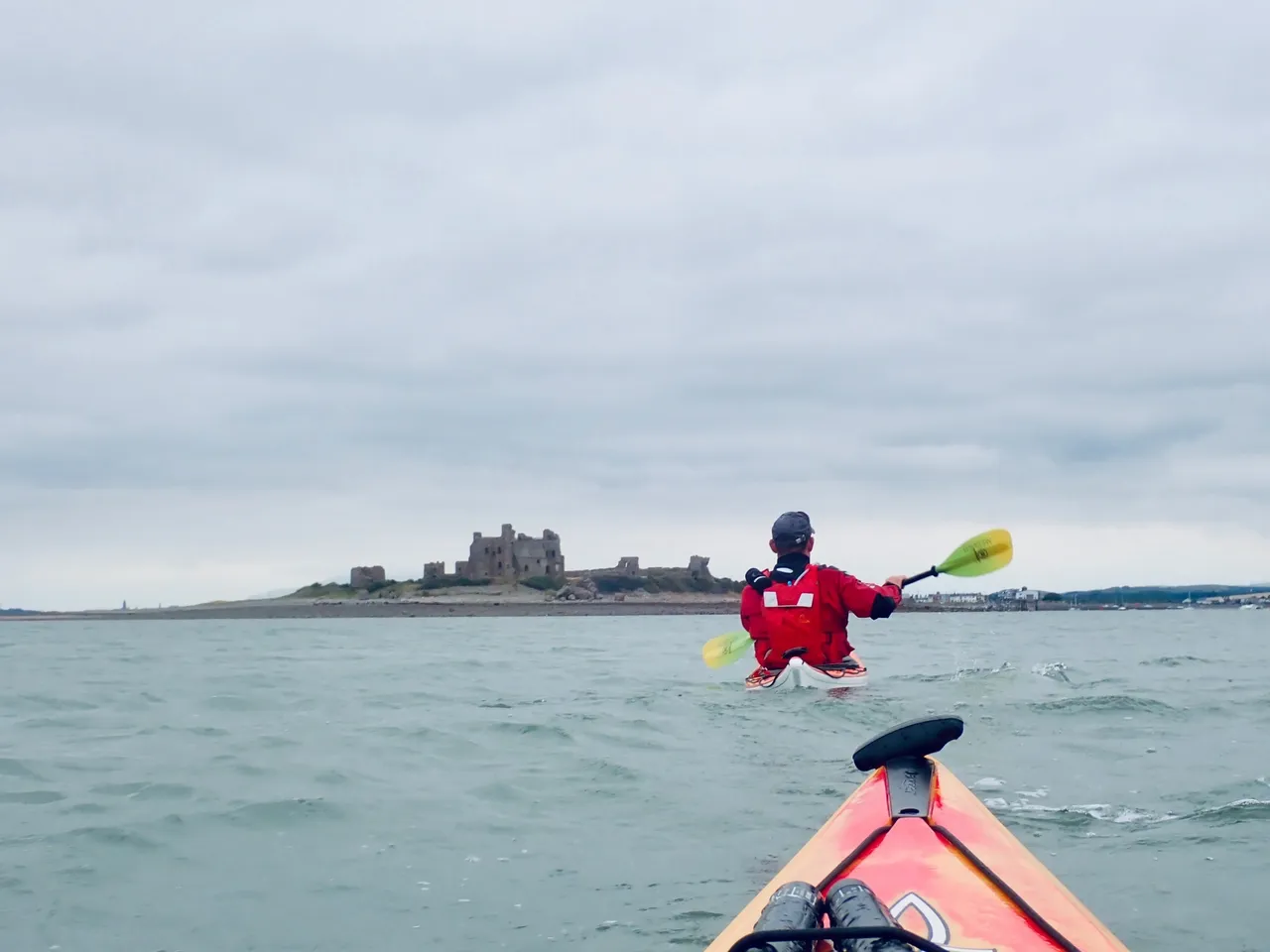
    It didn’t take us too long to reach the bottom of the island; we turned left and were treated to our first glimpse of Piel Castle. It looked incongruous, a ghost from the past. The castle still dominated the island, even as a ruin. 

    We landed by the ferry slip. Steps led up to the Ship Inn. The landlord of the Inn is also, officially, the King of Piel. So, we found the King, a friendly man in his 30s not long crowned and busy behind the bar. A loud, well-oiled customer was trying to hold court with some story or another, clutching the counter with one hand. There were half a dozen or so other customers, all desperately avoiding any eye contact with him. Everyone looked around as we walked in; dressed as we were in rubber trousers, cagoules, and buoyancy aids, we were definitely a welcome diversion. 

    I asked the King if we could camp on his island.

    “Anywhere you like” was his easy reply. £5 per night, an exceptional bargain. 

    Everywhere around the pub was already fairly chock-a-block with tents, so we got back into the kayaks and paddled 400m or so around the coast, settling on a flat, grassy strip not far from some of the houses. 

    Tent and sea kayaks at our grassy campsite on Piel Island

    Once the tents were up, we found the castle – note the opening hours “Any reasonable time”. The King joined us with his dogs briefly; without saying it, he clearly needed a little bit of time away from the bar. 

    English Heritage information board beside the ruins of Piel Castle

    We dined on dehydrated Chicken Tikka Masala and then adjourned to the bar. 

    We found a side room full of nautical curiosities and photos and made ourselves at home. Several pints later, long after it had got dark, a private number called Nick’s telephone. It was Cumbria Police – the parish council car park committee at Silecroft had seen us paddle away over the horizon and were worried as our car was still there. This had caused a terribly embarrassing sequence of events – Bedfordshire police going to Nick’s home address, getting contact details from his wife, passing them to Cumbria police. We made our apologies to the police and thanked them for their concern.

    Sea kayak on the shore at sunrise with boats anchored offshore

    We had a very early start the next day; high tide was 08:00, we needed to be well clear of Duddon Estuary on the way back. I needn’t have set an alarm because at 5 a.m. a dredger passed seemingly a few feet from our tents, making a noise like a surprised cow. 

    We had filled our flasks with boiling water the night before to save time, so breakfast was a perfunctory porridge and tea before we got back on the water. 

    Kayaking past the shipyard buildings and cranes at Barrow-in-Furness

    We reached BAE Systems (where they make nuclear submarines). A massive contrast to be amongst such a futuristic estate only a short paddle from a 14th-century castle with its own reigning King. 

    Under the road bridge and by the time we hit the estuary, the wind was picking up considerably. The waves were coming in at between 45 and 90 degrees, and they were breaking into surf as they got closer to the land. Surf is a problem for kayakers; there’s not a lot you can do if a wave breaks over the side of your boat. It would mean a certain capsize, potentially loss of kit, injury, and a cold dunking. We deliberately took a path further out to sea, balancing the risk of being unable to swim for shore vs hopefully not needing to. 

    It was probably just slightly the wrong side of enjoyable at times. Loaded boats tend to be better to handle in these conditions, and thankfully, we had a considerable cargo of un-drunk beer thanks to the pub being open. 

    We’re pretty good at keeping each other’s spirits up and soldiering on. We only stopped once, for a quick brew from a flask because the conditions were set to deteriorate further. 

    I was starting to think about landing and carrying the boats to the nearest road, but it didn’t quite come to that as Silecroft grew from a dot on the horizon to the very welcome sight of Nick’s parked car. With an angry-looking lady standing next to it, hands on hips. It was going to be telling-off time. 

    “I know exactly where you’ve been.” 

    We must have looked fairly sheepish; her expression softened a little. All the same, she had definitely been looking forward to this moment and was not going to be easily deprived of it. We had a chat for about five minutes, explaining we were just local guys out for some harmless adventures. I made a genuine apology, and with that, and a suitable contribution to the car park honesty box, we were on our way home for fish and chips. 

    Resources

    Trip planning was assisted by the excellent guidebook: Northern England and IOM – Fifty Great Sea Kayak Voyages by Jim Krawiecki. (Amazon affiliate link)

    A page of all the gear I use for kayaking, camping and hiking 
  • The Summer Isles

    The Summer Isles

    We arrived at Bardentarbet Pier just after midnight. I pitched my tent behind the car. Nick slept at the wheel with the seat back. By 5am it was light and the midges had already decided to choose violence. They attacked my face the instant I unzipped my tent. 

    Chunky, rough cobbles covered the beach between the road and the sea. Unfortunately, we put the boats down in the diluted liquor that was oozing out of a bloated, dead sheep. We hastily sidestepped onto clean ground. 

    We took it in turns to take the car a mile back the way we had come for a final porcelain poo. 

    As we shuttled back and forth from the car to the boats, I found a pair of Nikon binoculars in a see-through Lomo dry bag. They were compact, weighty and of very high quality with a metal body and glass lenses. They had been carefully sealed in the bag. Surely only another kayaker would have dropped them there. I stowed them safely out of sight in the car planning to try and trace the owner at a later date. 

    We paddled off, aiming directly for Tanera More. I’d read about it already; it was said to be privately owned and protected by security guards. We took a look at the settlement without getting too close, continuing clockwise. 

    MSR stove and mess kit being used to make breakfast on a stony beach.  Nick standing nearby in kayaking kit

    A shiny-looking Land Rover Defender appeared to keep us in sight as we rounded the corner. We avoided that and found a nice secluded midge free beach where we could brew up and have our breakfast. 

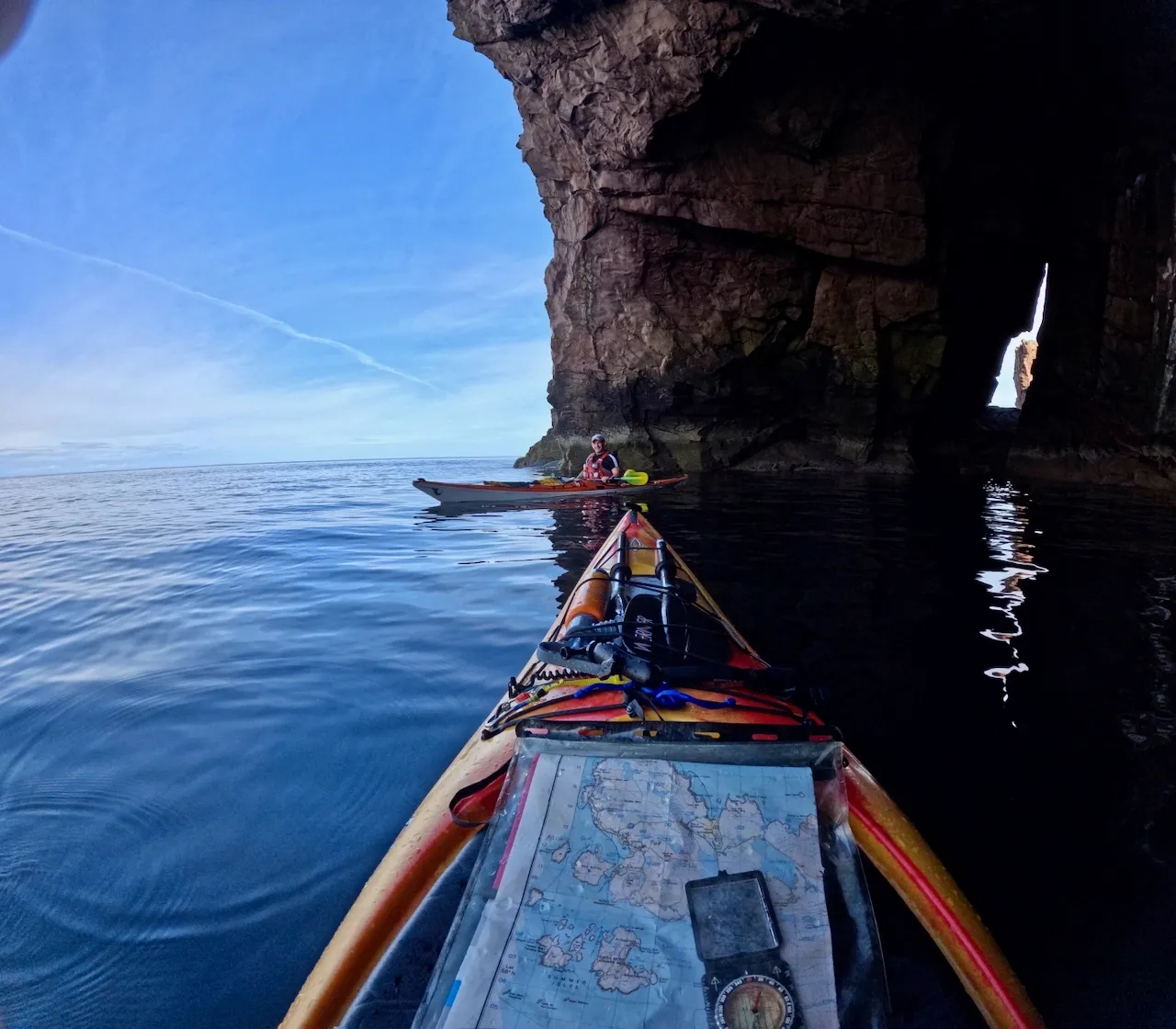
    Sea kayak afloat on a calm blue sea, map and compass on splash deck, second kayak in the distance.  Arches overhead.

    We paddled about 30km circling the islands, paddling into caves and getting a feel for the area. Two or three dolphins breached nearby. It was pretty well flat calm with sunshine all day, we had been very lucky. 

    MSR tent pitched on a grassy shoreline campsite in the Summer Isles

    At just after 4, we settled for a scrappy, rough campsite on west side of the uninhabited island Tanera Beg. We had a dodgy carry-over of more slippery cobbles to get the boats clear of the high tide mark. What had looked like flat, green grass was actually six inches or so of undergrowth, gorse and heather. It was flattish. There was plenty of driftwood though and no “neighbours” to offend. 

    We’ve executed this drill many times now, so we were all set with tents pitched and settled in within 45 minutes. 

    Personal admin is of critical importance on these trips. We stripped off to our undercrackers and wobbled our way back into the sea. I’ve got some travel soap that seems to be ok with salt water. I used my microfibre travel towel to dry off, a blast of Lynx and I was ready for my clean, dry clothes. 

    Nick is the designated firestarter but I helped gather a respectable pile of washed-up fence posts, pallets, branches and twigs. Dinner for me was an Uncle Ben’s rice and tinned salmon followed by a nice cup of tea and a chocolate bar. Nick’s more of a boil-in-the-bag man. 

    Two campers wearing midge nets on a rocky beach

    The next bit is my favourite. 

    Lighting the fire and pitching into some tins of beer. Guinness or Adnams Ghost Ship for me, Shipyard for Nick. I don’t know how many, definitely too many. Beer, fire, shooting stars, satellites, pretty amazing to think the closest other humans were several miles away and separated by water. 

    We had a fair night’s sleep and awoke to a midgey breakfast, porridge for me, boil in the bag all-day breakfast for Nick. Nice cups of tea. 

    If you’re eating, sleeping, and bathing in the wild, you’ve also got to have your daily Richard III wherever you may be when the need arises. I used to worry about that, but these days it’s no issue at all. I take a little orange trowel down to where the sea meets the sand, dig myself a hole about six inches deep. Ideally, just in front of a rock or something I can brace my back against. Trousers and pants off, bombs away, bury it, and then waddle into the sea. Once you’ve wiped your arse with wet, soft seaweed, you won’t look back. It’s very nice. Very kind on the anatomy. A quick sluice of seawater, a spot of soap, and jobs a goodun. You don’t want to cut corners with these drills, the last thing you want is nappy rash. 

    Welcome back if you skipped the last paragraph. 

    We got underway. Heading south east towards Horse Island. On the way, Nick, with his eagle eyes, saw dolphins breaching about one kilometre away. I don’t tend to notice these things as I’m a) short-sighted and b) map reading. 

    We wouldn’t dream of disturbing wildlife, but as it was, we were headed that way. 

    Twenty minutes later, we met the dolphins. There were about 25 of them, arcing out of the water in twos and threes, playing, enjoying their athleticism. For fifteen minutes they crashed in and out of the sea, sometimes as close as ten feet from me. I have rarely felt quite so alive. I could smell them. I was being lightly splashed as they re-entered the water. They created a wall of sound with their snorting, breathing and smashing into the sea. I held my underwater camera beneath the hull, hoping to capture it.

    We both managed a bit of film which I have edited together here.

    As we ate our lunch, the coastguard transmitted a missing person bulletin on VHF channel 16. A lady, in her sixties, on her own, out in a kayak, not too far from us and overdue back to her family. We know each other from our time in the police, so we both mentally switched on. When we peered into the distance, we saw a sea kayak slowly heading our way with a grey-haired paddler. Surely not! 

    The paddler had seen us; at 30m, we realised it was a man, not the missing person then. He stopped for a chat. Straightaway, he was two leagues better than us. His composite sea kayak was well used, patched in places but of top-notch quality. His gear was high spec, slightly sun-bleached. He had a dry suit, we were in t-shirts. He was about 70. We made him a cup of tea and swapped war stories of kayaking trips past. He was humble, a soft East of Scotland accent, clearly a highly accomplished paddler. 

    He very politely and diplomatically put it to us that we were a bit risk-averse and challenged us to up our paddling game. This was a breath of fresh air as most people we meet tell us we’re going to die! 

    He showed us some of his kit, I noticed he had a medium sized plastic bottle with the bottom cut away just in front of his seat. I’d had to make myself one of those once when I needed to empty my bladder, but we didn’t comment on it. He proudly showed us a pool noodle that he had modified as an aid to self rescue in the event of a capsize. 

    As an aside, I mentioned the binoculars we’d found. His smiling face broke into a beam, he explained that his was the car next to ours back at the pier. He had set off a couple of days before us. He had lost his binoculars but did not know where and had been emptying his kayak and retracing his steps totally unaware that they were left on the beach where he had set off. He described them to me, this was unnecessary as I was already totally convinced he was a genuine person. I took a note of his address and asked for his phone number so I could confirm he would be around, these were valuable and would need special postage. I found it quite charming that he did not know his number and his phone was safely powered off inside a dry bag in the depths of one of his hatches as he got it out and looked it up for me. 

    Mr W told us the best place to camp. He went north, and we carried on south to the beach he recommended

    A selfie of me with Nick's  tent pitched above a secluded rocky beach in the Summer Isles

    This was a proper, perfect campsite. Actual flat grass, sandy beach, bountiful firewood, and even a fireplace. Just before we turned our radios off for the night, we heard with relief that the missing lady kayaker had returned in one piece. 

    Campfire burning beside a rocky cove at sunset

    As the tide fell, Nick noticed the remains of some wood structures and rocks that we surmised were to hold fishing nets to sieve the small bay’s catch from the retreating sea. We thought about those who had gone before, sat around a fire on the exact same spot as us, bellies full of fresh fish. 

    When the sun settled, the midges came out. These were the worst midges I’ve ever experienced in my 46 years. 

    I’ve spent a lot of time in Scotland. This was the midge apocalypse. Words cannot convey how serious this was. It was not a case of the air being thick with them. The air was them. Every inhale sucked hundreds of them into my throat and lungs causing sharp coughs. They filled my ears with tiny, whizzing screeches. My eyes itched and wept involuntarily. We both had mosquito nets, but it was unbearably humid and unpleasant underneath them. My snood was literally a lifesaver. I used it to cover my ears and mouth, I think I would have gone insane otherwise. 

    We both had to abandon our beers and head into our tents. It was that bad.

    Overnight, my eyes started discharging sticky pus. My eyelid muscles were not powerful enough to open, so I had to manually pry them apart with my fingers whenever I needed to see anything. 

    Things were not much better the next day, so we packed up and fled into our boats. Midges never seem to follow us more than 20 ft or so out into the sea. 

    We headed back north, taking a meandering route around the northern summer isles. More arches, caves, and dolphins. 

    Large dead marine animal floating beside a kayak in a rocky cove

    We discovered a cow-sized dead animal floating in a little cove. Probably a whale. The sea was getting lively, so we pressed on for the commercial campsite at Altandhu

    Tents and sea kayaks on the beachside camping terrace at Altandhu

    All the other campers had gravitated towards the upper pitches, near the road. We were the only ones to arrive by boat, so we had the lower beachside terrace to ourselves. We paid the man and luxuriated in lovely hot showers. 

    Two kayakers enjoying celebratory drinks after the Summer Isles trip

    The pub next door (Fuaran Bar) was busy. They were serving food but told us there were no tables. But there was room in the bar. And they were doing takeaways. So we had takeaway fish and chips at a table in the bar. And many, many pints. 

    The last day was easy, a 6km paddle back to the car and home. 

    When I got home, I sent a text to Mr W and he gave me his address. I carefully wrapped his binoculars in bubble wrap and put them in an old amazon box, they were sent special delivery. He sent a very gracious thank you, his offer to pay for the postage was declined and we both said we would meet up if we’re ever in each other’s neck of the woods. 

    When I think back on this trip – the dolphins, the apocalypse midges, the perfect campsite – what stands out is Mr W. We only spent an hour with him, but his influence was lasting. He challenged us to be bolder. He shared his best campsite. He showed us a little into our future being decades older than us and still in the midst of our shared hobby. And somehow, through pure chance, we were able to return something valuable he’d lost. That felt right.

    This trip happened between 17 – 20 July 2025. 

  • ROC Bunker

    ROC Bunker

    I’ve enjoyed visiting my in-laws a lot more since they moved to the countryside a few years back.

    Whenever I walk my dog from their place, I pass a Royal Observer Corps Cold War monitoring post. It’s been decommissioned since 1991. Sat in the corner of a farmer’s field next to a busy A road, you wouldn’t really know it was there.

    There’s space for a couple of cars just off the road. Most people who park there have no idea how close they are to a Cold War time capsule. Takeaway wrappers, NOX bottles and a sadistic-looking Richard III discourage you from taking the narrow path that leads up to it.

    There’s a concrete box rising from the ground with three steps built into it. A green metal lid sits on top. It has two hasps, one on each side where it would once have been locked, but they’re long since cut. It still opens easily, well designed with a counterweight, though these days it makes a painful graunching sound.

    Under the lid is a white-painted, concrete-lined shaft with a metal ladder set into the far wall. It goes down about fourteen feet into damp-looking darkness. I went down for another look on Sunday. This time the lid wouldn’t stay open, so I let it close gently. There was still light getting in, so there must have been air.

    I climbed down halfway; it was getting dark. My imagination ran away with me, wondering if there was anyone waiting for me down there. I held my breath and listened. When I switched on my torch, I could see where I’d be landing, so I carried on.

    At the bottom there’s a toilet or store cupboard on one side and the actual bunker on the other. Only a small space, about the size of a single garage. The walls were once white but are now covered in graffiti. The floor was a mess of smashed-up wooden pulp – presumably what’s left of the doors and shelves. It had a musty, dirty stench. Surprisingly, I could still hear every passing vehicle on the road above. I’d expected silence.

    I looked up at the metal flange on the ceiling that once held the monitoring equipment. Shining my torch into it, I saw a pipe running up to the surface.

    There would once have been a wall of communications and recording apparatus. Now there are only a few wires and holes where it was ripped away when the post was decommissioned.

    A minute or so was plenty. I appreciated the fresh air and sunlight when I lifted the hatch and climbed out.

    I find it fascinating that there were so many of these things – one every eight miles or so, enough to triangulate any blast and then measure the fallout afterwards. They were staffed by local volunteers; once a month they’d unlock the hatch and descend for training. In a real activation, three of them would have spent up to two weeks locked in, monitoring and sending signals.

    Most have been sealed up or filled in, some lovingly restored. Others, like this one, are probably getting a bit dangerous thirty-four years on. I don’t think I’ll go back inside again.

    Still from the YouTube video - looking down the white painted narrow shaft, rusty lid stood vertically on its hinges, ladder leaning against the far wall.