Tag: short-story

  • I’ll follow your feet

    I’ll follow your feet

    I’m on the last leg of a 900-mile railway journey. I’ll soon forget most of it, but not the man I sat next to under the Channel Tunnel. He was in his seventies, twinkling with fun. We chatted for two hours. He had been a professional musician all his life. Somewhere near the Kent coast, he told me he’d had a hard time finding his way through the station to where he was sitting, as he could not see very much. He explained he’d lost most of his vision a few years back. He wasn’t ready for a white stick; he didn’t want to be perceived in that way. He had asked a lady which platform the London train was from, and she’d pointed to a sign that he could not see, he’d sensed a bit of unkindness in her.  

    We talked about his music. I had a look on YouTube; he was surprised to know that his songs were on there. I told him if he uploaded them himself, he might be able to get some income from them.

    He was proud of the cousin who was going to meet him. With difficulty, he found a photo of him stood in front of his house. I had an hour between trains, so I asked him if he’d like to follow me through the station when we arrived. He said “no thanks, I’ll be fine.” He was a proud man.

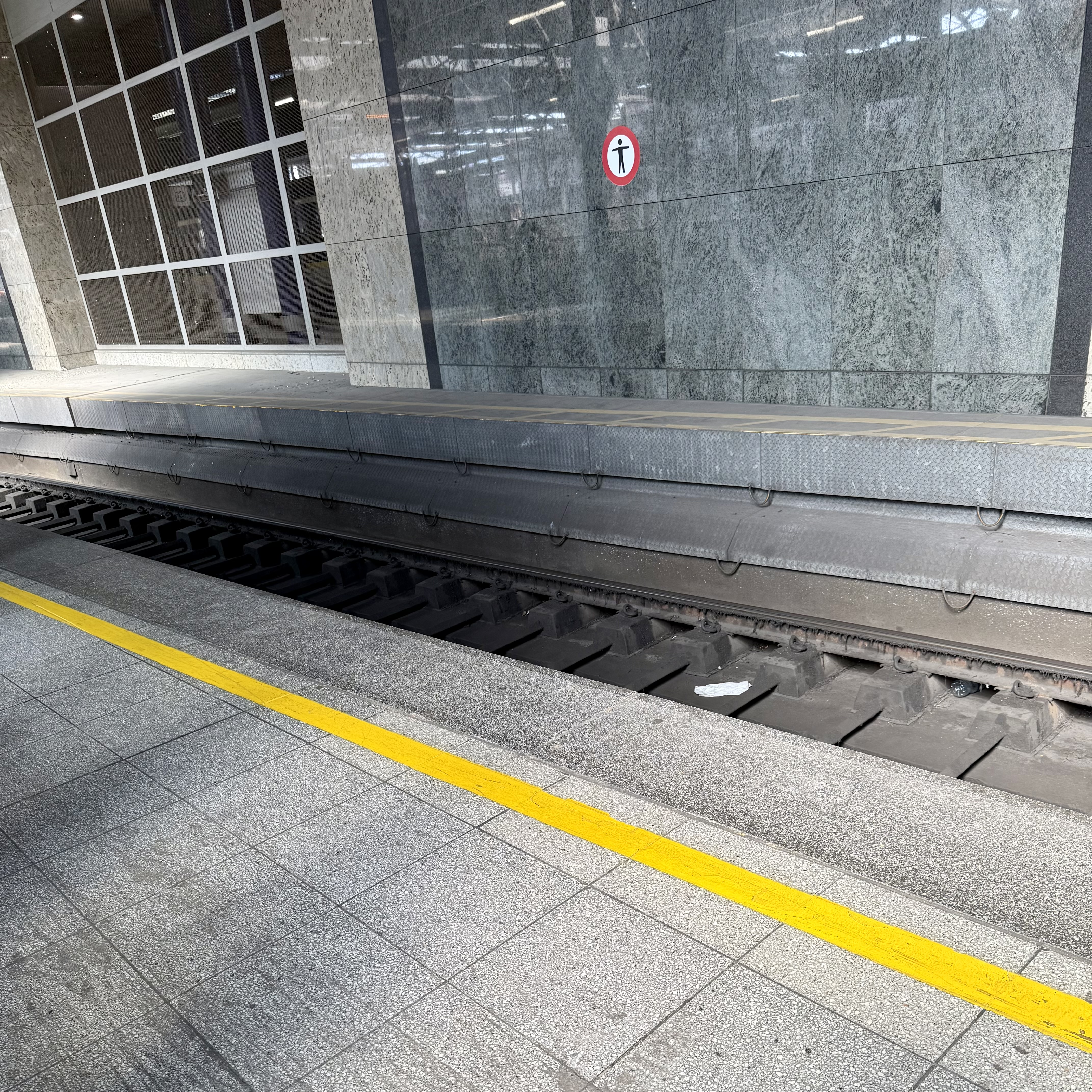
    We waited for the carriage to empty. I made to carry his bag, but he wanted to do it. I walked ahead; he paused at the door. I told him how many steps there were and that there was a big gap to the platform. He passed me his bag, and I held my arm out to him as he stepped down.

    The platform was teeming with people, all going in the same direction. I didn’t really know what to expect myself, as it had been ten years since I used this station. I offered my arm, but he said “you walk in front, I’ll follow your feet.”  Despite that, I felt a hand on my shoulder a few times.  

    On the escalator, I told him it was the kind that has steps, not a slope. At the bottom, I told him when it was time to start walking. He told me he had nothing to declare customs-wise. 

    As we reached the arrivals area, I recognised his cousin from the photo. A nice-looking man a little younger than me, he beamed at us, recognising what was afoot. We shook hands, all of us, and I left them to it.

  • The car in the distance

    The car in the distance

    Dog walkers are always making grim discoveries. I was 18 when it happened to me.  

    I was with my terrier. I saw a small car in the distance. It was out of place, far from the nearest road. 

    I wandered over, curious. The windows were all misted up, the engine was ticking over. I could hear loud music playing. I circled around it, not getting too close in case it was a couple.  

    There was a garden hosepipe coming out of the exhaust. Someone had tried to seal it in place with red insulating tape. I took a step closer. There was a man in the driver’s seat, his forehead almost touching the steering wheel.

    This was 1998. I had no mobile phone. I shouted “Help” and paused, holding my breath waiting for a reaction. There was none, nothing from the man in the car and not a sound from anyone else. I could not see another soul in any direction. I felt I had to do something. I pulled the hosepipe out of the exhaust. At least things could not get any worse now.  

    I tried the door handles. All three doors were locked. The passenger window was cracked open to let the hosepipe in.  

    I kicked the glass as hard as I could, connecting with the flat of my foot. Nothing happened.

    I found a hefty stick. The window smashed to pieces the first time I hit it.  

    I reached in and unlocked the door.  The air was hot. It caught my throat even though I tried not to breathe. I leaned across the man’s shoulders and unlocked the driver’s door.  I walked around to his side and opened the door. He was cherry red, unconscious, floppy. He had been sick on his lap. He had no seatbelt on. I took his arm and pulled. I’d never been around an unconscious person before. The way he fell to the ground was disturbing – he behaved like an object rather than a person. He landed on his side. I rolled him onto his back.  

    I slapped his face gently. His eyes were fixed, unfocused. I gave him a few chest compressions whilst I thought about what to do. I’d never done that to a real person before. It felt horrible, violent. There was froth coming from his mouth, so I decided against any mouth-to-mouth.  

    The CPR wasn’t doing anything, and there was nobody else around. It felt wrong to leave him by himself. I knew if I went to get help, it would take too long by the time I took them to him.  I decided to try and move us both closer to the main road.  

    I tilted the driver’s seat forwards and dragged his upper body back towards the car. Somehow, I bundled his torso into the space behind it. He was a bit bigger than me, so I couldn’t get his legs in. He ended up on his front with his face resting on some of the broken glass. As I put the seat back down, I felt resistance; I think that was his arm. The windscreen was still steamed up on the inside, and the wipers didn’t help.  I didn’t want my dog cutting himself, so I kept him outside on the end of his extendible lead. The gearbox and pedals were different to what I was used to. I found first gear and let the clutch out, slowly, with lots of revs. I had to go about a third of a mile around a ditch to get towards the road. I was hooting the horn because I couldn’t really see where I was going. I noticed a flattened cardboard box on the passenger seat. It had once contained a car foot pump. I would read it later; it said “to whoever finds me.” The handwriting started off very neat but by the end it had faded to a scrawl.  

    I stopped just near where my own car was parked. A couple were just about to start their afternoon walk; they looked frightened. They soon realised I needed help and ran over. She was a nurse or a midwife; she was much better at the CPR than I had been. A small crowd started to form; someone must have had a phone, and a 999 call was made.  

    Within a few minutes, the ambulance arrived; they took over. The defibrillator didn’t make any difference, and after a while, they stopped; they put a red blanket over the man. 

    The police came. There was a sergeant in his 30s, plain clothes. He asked me to show a young PC the place where I’d found the man. The PC told me not to blame myself. Until he said that, the thought hadn’t even crossed my mind.  

    I gave my details, and they said I could go. 

    A few weeks later, a retired policeman from the Coroner’s office came to see me at my mum and dad’s house. He took a statement. 

    I had to go to the inquest. I went on my own. I found myself sat next to the man’s wife as we waited for it to start. As a sixth former, I didn’t really know what to say to a lady whose husband had died like that.  

    I didn’t read my statement as such. An official had a copy of it in his hand; he read it out as a series of questions that I could agree with. That was it; they said I could go; I never heard any more.  

    I’m 46 now. Every day, I still think about the car in the distance and the man inside it. It didn’t do me any harm, but my life was different after. I’ve carried on doing my best to do the right thing and not to look the other way. I’ve had some good adventures doing that. 

    If you feel you are affected by the issues raised in this post then please speak to the Samaritans, click here to visit their website or call 116 123.

  • The 0802

    The 0802

    I’m neurodiverse. I am oblivious to many things that stand out to typical people, but yet there are other, almost invisible streams of information that shout at me. 

    People would say I can’t read the room. But that’s not true. Reading the room is addictive, narcotic, exciting; I love doing that. Computing how to behave, how to stand, where to look, what facial expression to adopt, what’s safe to talk about—that’s hard. But I don’t complain; I’m lucky. I’ve learned about myself. 

    On the 0802 to Birmingham, I was hyper-aroused. Trains can be chaotic, dramatic, bursting with vignettes if you’re curious enough to look. 

    A man in his thirties, tattoos around the side of his neck and across his throat. Four-five days of stubble, a shaven head. Grey tracksuit bottoms, baggy, dirty. No name trainers, white socks. 5’7 or so, about 10 stone. Angry, very angry. Also, afraid. Black rucksack on his back, one strap only. A cheap rucksack, thin straps; the black fabric had a white/grey tinge to it. Stuffed full, the fabric drum tight. Carrying/dragging another suitcase that came up to the middle of his thighs. Walking quickly, jerky, stabby movements, his eyes working, staring through the electric door into the carriage beyond, scanning for what? For who?  As he reached me, I saw he also had an extendable dog lead with a small, black bulldog on the end. The lead stretched taut, the dog an unwilling passenger, ears back, tail down, front legs braced forward.  

    You get a fresh cast at every station.  I was watching. The tip of a white stick flicked left to right, left to right, coming closer to me at less than a walking pace. The movement— deft, skilful, like how a bricklayer’s trowel becomes a part of them. The stick belonged to a woman; I could see slim legs wearing grey tights. Suede boots up to the knee, a black skirt with a cardigan. Three rows in front of me, she stopped next to two empty seats to her right. She stepped into the space between the seat cushions and the back of the row in front, her face pressed up to the feeble LCD display that tells you the seat number and whether it’s booked or not. She was confident, independent, far from helpless. An undertone of defiance.  

    A second lady followed her into the space.  Older, sixties maybe. Grey hair. Kindly, maternal, a bit worried. Speaking to each other, not sitting down yet. They made no eye contact with any of the other passengers who were looking their way. Something about the angle of the younger lady’s shoulders and a little nod of the head told me she was the decision-maker. They sat, the older lady in the aisle. They just had handbags, no suitcases. I could only see the older lady now; she too had a white stick, she folded it away into her bag. She held her iPhone to the tip of her nose, took it away again, and took a small, black microscope from her handbag. She held it between her eye and the screen of her phone; it looked uncomfortable.  

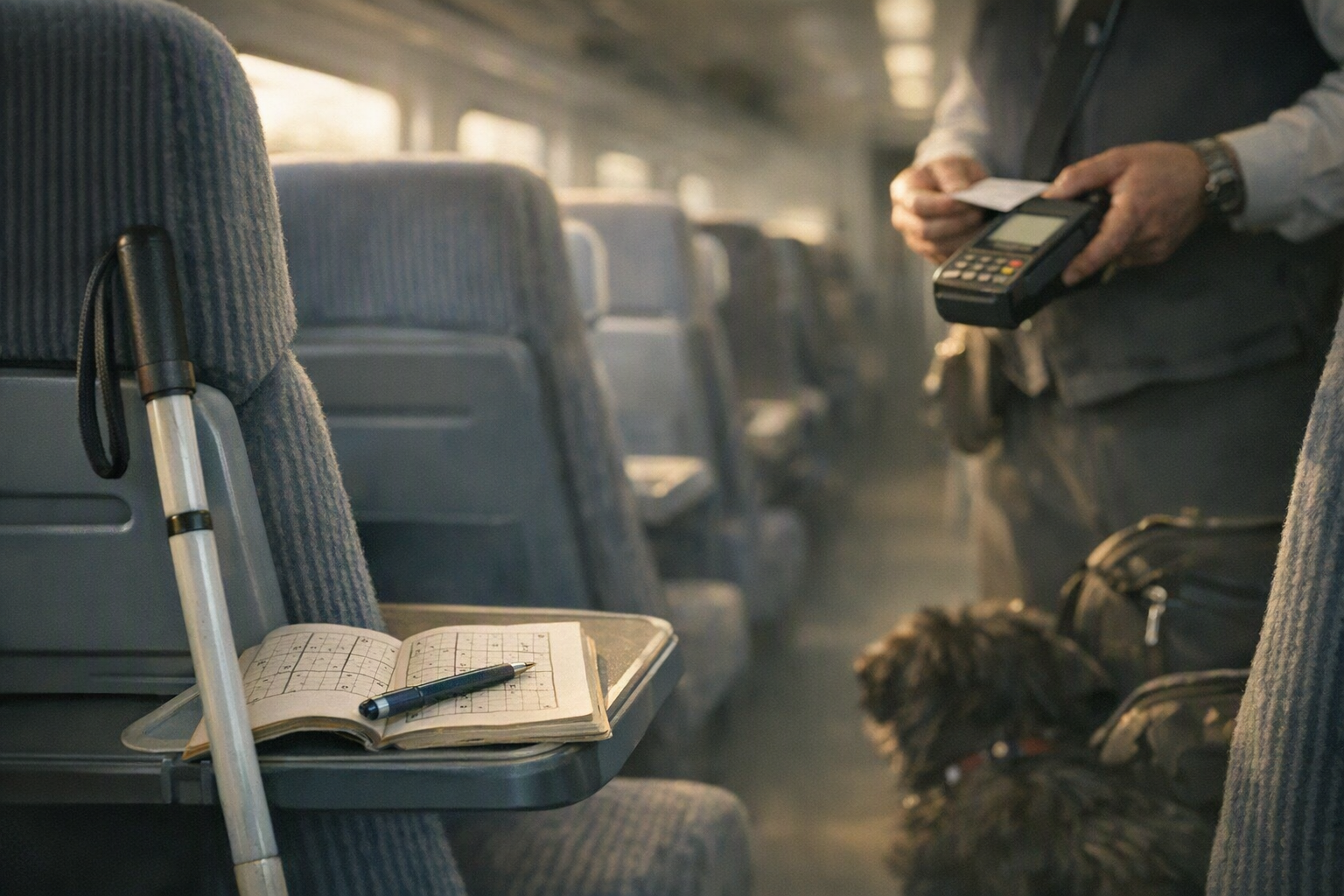
    Another station, more new faces. A lady, late fifties, arrived from behind. Sensible, sensible shoes, a calf-length dress, a tote bag. Straight grey hair. Glasses. She was reading off the seat numbers to her left; she slowed as her peripheral vision told her that her seat was taken. She slipped into the seat in front, took her phone out, and shuffled around getting the right app open. She looked back and forth from the phone to the seat numbers, but only for a second. Her mouth set into neutral; a decision made, she sat where she was. Took out a Sudoku book on sand-coloured paper; a biro scratched away at the pages. 

    A male voice, ever so slightly louder than the background chit-chat, confident, authoritative.  Coming towards us. He had found the right volume and cadence of speech to switch his passengers on; tickets and screens were ready and waiting. He stopped at the pair of ladies, studied the screen of the older lady, and asked if there was a pass to go with the ticket. She rummaged. An arm appeared from the window seat, clutching a plastic wallet. The older lady said they were not sure if they were in the right seats. Screens checked again. The guard looked back over his left shoulder, “One of you there, and the other where you are.” But this wasn’t an instruction; his voice was soft, unthreatening; he was just explaining. He said he would keep an eye out, and it would be fine. One of the seats had been booked from the station before anyway. The other lady raised her head from the Sudoku book and said, “Oh, that was me actually, so don’t worry.”  

    I was so invested at this stage; I gave her an involuntary beam, so did the ticket inspector. Something, I don’t know what, I could see no faces, but something told me that the passengers around me had all been holding their breath a little; a millisecond of silence ended, the tension burst with this release of kindness.  

    I felt the familiar prickling in my eyes that comes with shared emotion; I felt good; I was amongst kind, sound people; we had all shared a little moment together on the 0802.