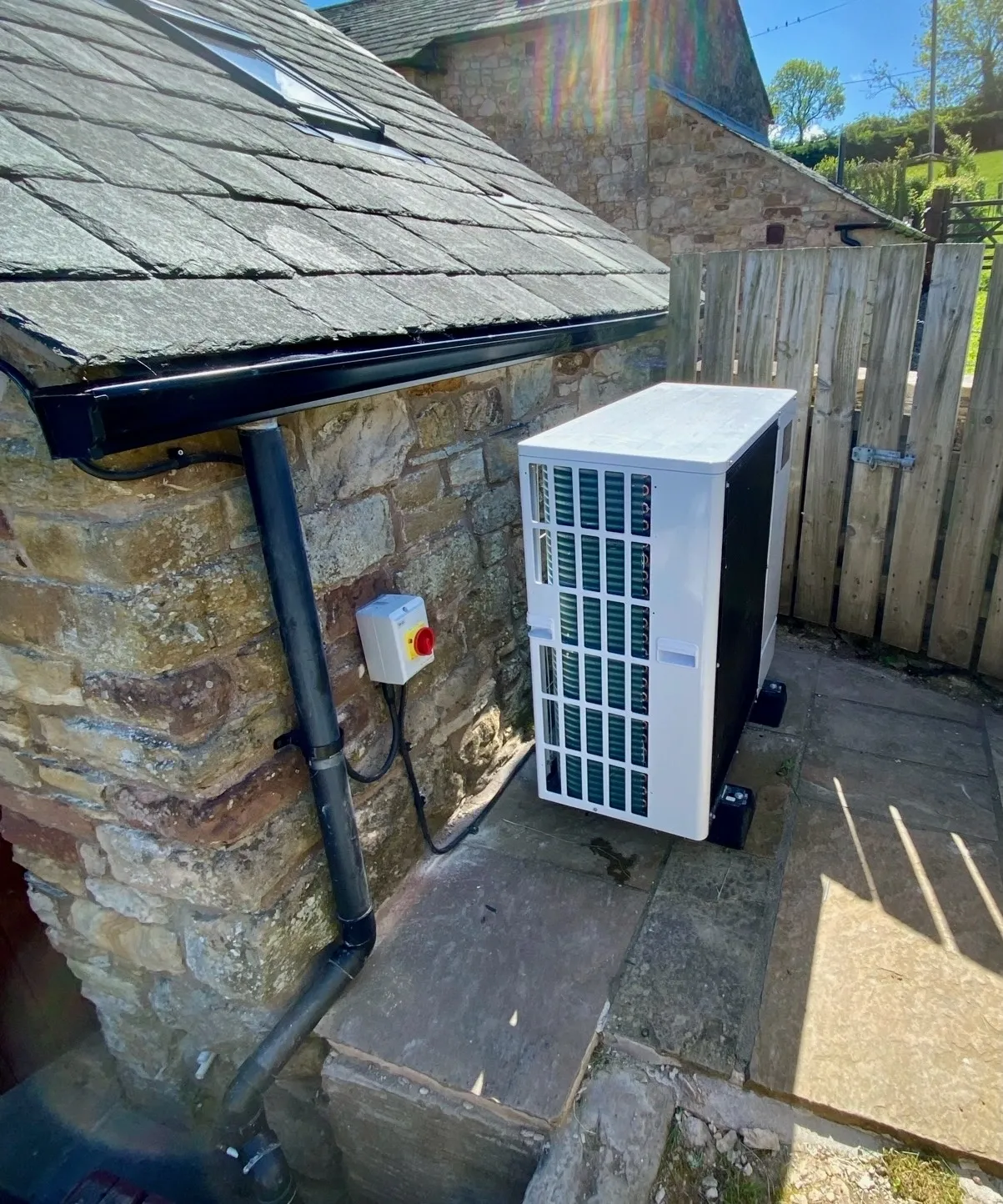
We have lived in the same house for 12 years. We had an oil boiler for 7 years, and 5 years ago, we changed over to an Air Source Heat Pump. I am sharing my data on oil and electricity consumption to help you decide whether this is for you.
My full dataset and calculations are available here:
In conclusion
- Over 7 years, our boiler used 5.02 litres of oil per day
- Over 5 years, our heat pump used 13.01 kilowatt hours of electricity per day
- Both systems delivered broadly the same amount of heat into the house in real-world use (around 43–47 kWh per day)
- We made no major changes to radiators, plumbing or insulation in this time period
- To compare costs yourself: Price × 13.01 (heat pump kWh/day) and Price × 5.02 (oil litres/day)
- Based on today’s prices (oil £1.05 per litre and electricity £0.24 per kWh, the heat pump is roughly 39% cheaper)
- Real-world, same-house comparison using measured data (not manufacturer estimates)
Living off gas in rural Cumbria – costs, comfort and what actually changed.
As I often say, we live in an old barn on the side of a hill in the Lake District. We have no fibre broadband, no mains sewage and no gas. Each of those has presented its own challenges, most of which I’ve enjoyed solving and writing about (see my pieces on Starlink and our sewage tank).
Today I want to share our experience of installing and living with an air source heat pump (ASHP).
Our house
The building dates from the 1800s however it was converted into a house in 2008 and has very good insulation. We have underfloor heating in every room. The EPC was a C before we got the heat pump fitted. It’s 4 bedroom, 2 story, 181 square metres and, according to the EPC, the primary energy use for this property per year is 134 kilowatt hours per square metre (kWh/m2).
The old boiler
In 2013, when we moved in, the house came with an oil boiler and a large 1,200-litre green plastic tank in the garden.

The system was relatively new and worked well with our underfloor heating. We kept it for just over seven years. The boiler was serviced annually but began breaking down once or twice a year. Replacement was inevitable. The question was whether to install another oil boiler or try something different.
Why We Switched
In 2021 the government was offering a £5,000 installation grant plus Renewable Heat Incentive payments of £188 per quarter for seven years. That made the economics worth examining.
As I say, our house is well insulated and heated entirely by underfloor heating, which makes it well suited to a heat pump. Heat pumps operate at lower flow temperatures often around 30–45°C for underfloor systems (sometimes higher in older radiator setups) whereas many boiler systems feeding radiators are typically set around 60–70°C, and historically were often run hotter. Lower temperatures are key to heat pump efficiency, but they require a larger heat-emitting surface area either oversized radiators or, ideally, the whole floor.
I obtained three quotes and chose the middle option at just over £10,000. The grant paperwork required some administration but nothing excessive.
There is currently a government Boiler Upgrade Scheme offering up to £7,500 towards the installation of an air source heat pump. Full details and eligibility criteria are available on the official GOV.UK website
Installation
The outdoor unit was positioned close to where the oil tank had stood, allowing the flow and return pipes to pass directly through the wall into the utility room.
The new cylinder went where the previous hot water tank had been. Because the boiler and tank were already in that space, the plumbing alterations were relatively straightforward.
Electrically, a heavy-gauge steel wire armoured (SWA) cable had to be run from the consumer unit to the outdoor unit. The installers routed it neatly and discreetly.
We opted for the Wi-Fi module and a wireless thermostat to allow remote monitoring and scheduling.
The installation took four days and went smoothly.

Five Years of Data
We are now 1,800 days in.
The dedicated electricity meter shows the heat pump has used 23,409 kWh.
That averages:
• 13.01 kWh per day
• 4,752 kWh per year
Running Costs
Oil averaged £2.31 per day over seven years between 2014 and 2021.
The heat pump has averaged around £2.47 per day, assuming roughly 19p/kWh on Octopus Agile.
That is close to parity, and that’s while maintaining a constant 18°C, warmer and more stable than we previously ran the house.
Direct comparisons are complicated because both oil and electricity have been volatile.
Oil prices rose sharply after 2022, at times approaching £1 per litre. Electricity prices also increased, but we chose Octopus Agile, which allows us to shift usage away from peak periods. With timer control this has been straightforward.
At today’s local prices 105p per litre for oil and 24.67p per kWh for fixed electricity — the heat pump works out at roughly 39% cheaper per unit of delivered heat.
If you’re running on oil, you’ll know that refilling often happens either side of Christmas. When prices were at their worst, a delivery could easily be £800–£1,200. The ASHP doesn’t eliminate winter spikes, electricity bills are still higher between December and February but I smooth that by paying a standing order into a savings account throughout the year.
Comfort and Experience
The house has never been more comfortable. It maintains a steady 18°C with small fluctuations above and below set point. The internal environment feels more stable and humidity is lower.
Unless it is very cold, the unit does not run continuously; it cycles efficiently to maintain temperature.
The hot water performance has been equally effective. I have programmed it to regenerate the tank once per day, which comfortably supports three to four showers plus normal domestic use. Larger households would configure this differently.
Unlike a boiler, you cannot raise the temperature of the house quickly on a whim. It rewards planning. If elderly relatives are visiting, dial in extra heat the day before.
Maintenance has been minimal. I replaced two expansion vessels myself for around £100 in parts. The oil boiler, by contrast, required annual servicing and regular call-outs.
One practical downside is that it can be difficult to find engineers willing to service domestic heat pumps. Our original installer appears to have ceased trading.
The Practical Differences
- The oil tank is gone.
- There is no smell.
- No checking levels in winter.
- No deciding how much to order.
- No tanker deliveries.
- No large lump-sum fuel payments.
- The system simply runs. It cannot “run out” in the way an oil tank can during a cold winter.
- We have regained a space the size of a small car where the oil tank used to be.
Future Potential
We have not yet added solar PV or battery storage. If we do, the economics will tilt further in favour of the heat pump. Oil offers no comparable flexibility.
Electric heating integrates with a decarbonising grid and allows optimisation over time.
Verdict
We have not halved our heating bills.
But we have:
- Stabilised running costs
- Increased comfort
- Reduced maintenance
- Removed fuel logistics
- Reduced exposure to oil price spikes
- Gained future flexibility
For our house, the decision has proved sound.
Leave a Reply